
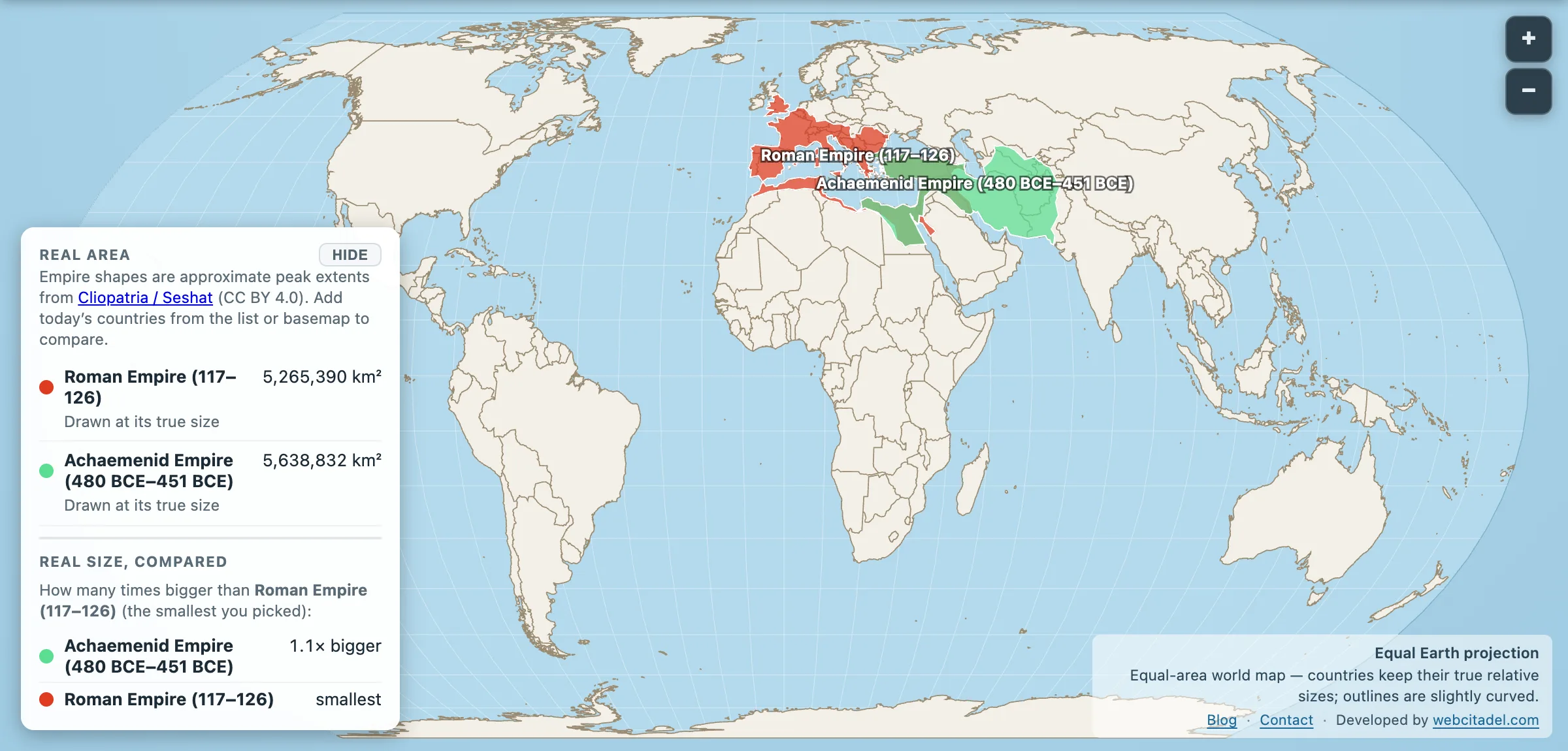
Ask anyone to name an ancient empire and you get Rome. The roads, the legions, the aqueducts, the entire genre of film. Rome is the default setting for the word “empire”.
So here’s the upset.
- Roman Empire at its peak under Trajan, 117 AD: 5,265,390 km²
- Achaemenid Persian Empire at its peak, around 480 BC: 5,638,832 km²
Persia wins, by roughly a Germany’s worth of land, and it did it about six hundred years earlier.
The empire your history lessons skimmed
The Achaemenid Empire, founded by Cyrus the Great and stretched to its limit under Darius and Xerxes, ran from the Indus valley to the edge of Greece and down through Egypt. By some famous estimates it governed around 44 per cent of everyone alive at the time, a share of humanity no empire has matched since.
And it ran on infrastructure Rome would have respected. The Royal Road covered about 2,700 km from Sardis to Susa, with relay stations that let royal couriers cross it in roughly a week, a journey that took ordinary travellers three months. Herodotus wrote of those couriers that neither snow nor rain nor heat nor darkness stopped them, a line the US Postal Service liked so much it’s carved above the old New York post office.
Rome’s counterpunch is fair. Its empire lasted centuries longer, and at its height held perhaps one in five humans alive. But even Alexander the Great, the man who actually conquered Persia, never matched its footprint. His Macedonian empire peaked at 4,946,358 km², still short of what Persia had held a century and a half before him.
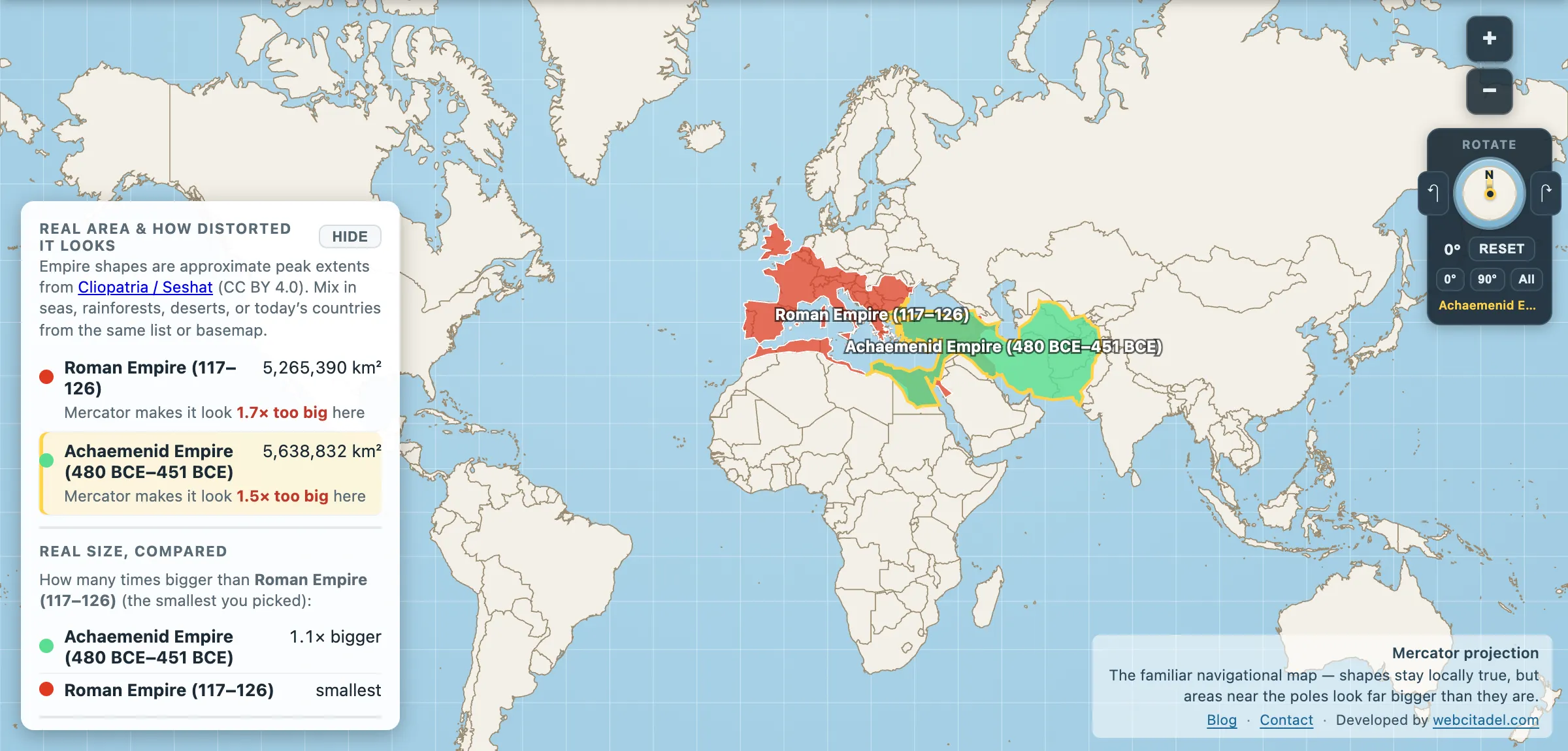
The same shapes on Mercator — the projection almost every map you see uses. Watch what it does to anything far from the equator.
Measure them yourself
Open Rome vs Persia on an equal-area map. Drag one over the other. Watch the Mediterranean superpower and the Iranian one trade territory, and notice how little they overlap. Two empires, six centuries apart, sharing little except Anatolia, Syria and Egypt, the most conquered real estate on Earth.
The usual caveat applies: ancient borders are best-effort reconstructions, not surveys. But the gap runs one way in every serious estimate. And neither of them, for the record, would make the all-time top five.