
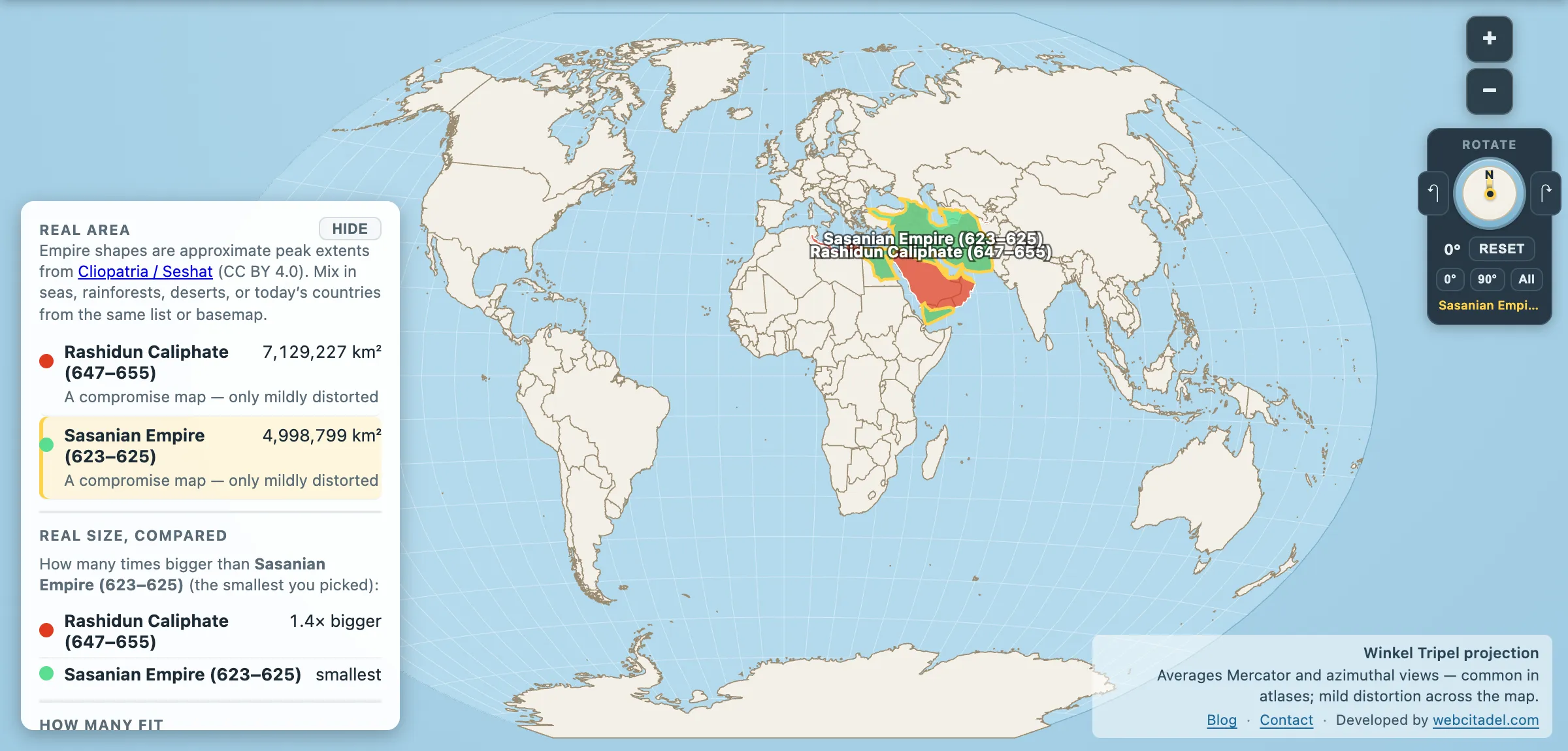
Empires usually take centuries. Rome needed about four hundred years to reach its maximum. The Qing spent a century and a half. The British Empire took roughly three hundred years to finish assembling.
The Rashidun Caliphate did its entire expansion in under thirty.
Rashidun Caliphate at its peak: 7,129,227 km².
From the death of Muhammad in 632 to the end of the Rashidun period in 661 is twenty-nine years. Seven million square kilometres across twenty-nine years works out at roughly 245,000 km² a year — near enough a United Kingdom (239,619 km²) added to the map every twelve months, for a generation, sustained.
Two superpowers, one window
The conquests are often told as a story of extraordinary momentum, and they were. But the timing was extraordinary too.
The Byzantine and Sasanian empires had just finished the last and worst of their wars — a grinding twenty-six-year conflict ending in 628 in which Sasanian armies took Jerusalem and Egypt and reached the walls of Constantinople, before Heraclius counterattacked into Mesopotamia and broke them. Both empires survived. Neither was in a fit state to do anything else.
Four years later the Arab armies arrived at exactly the seam between them:
- Yarmouk, 636 — Byzantine field army defeated; Syria gone.
- al-Qadisiyyah, 636 — Sasanian army defeated; Iraq opens.
- Alexandria, 641 — Egypt, Rome’s granary for six centuries, changes hands.
- Nihawand, 642 — described in Arabic sources as the “victory of victories”; the Sasanian state never recovers and is finished by 651.
The Sasanian Empire, at 4,998,799 km² one of the two great powers of late antiquity, was entirely absorbed. It is one of the very few times a first-rank empire has been not defeated but simply removed.
Why it moved that fast
Speed and logistics, mostly. Camel-borne forces could operate from the desert edge, which meant they could approach settled provinces on a flank neither empire had built its defences to cover, and withdraw into terrain nobody could pursue them across. Recruitment was broad and motivation was cohesive in a way that mercenary-heavy imperial armies were not.
And the ground was often less loyal than the map suggested. Syria and Egypt had populations at odds with Constantinople over both taxation and Christological doctrine, having been on the wrong end of imperial religious policy for decades. Conquest frequently meant a negotiated surrender of a city on terms — often lower taxes than the previous regime — rather than a siege to the last.
The Rashidun period ends in 661 with the Umayyads, who kept going. By 740 the caliphate was 9,894,755 km², nearly twice the Roman Empire. The Abbasids who followed held 8,176,166 km² and turned the momentum into something else entirely: Baghdad, the House of Wisdom, and the translation movement that kept a great deal of Greek science in circulation while Europe was mislaying it.
See the empire that vanished
Open the Rashidun Caliphate with the Sasanian Empire. Drag one onto the other and watch a great power disappear inside its successor — Persia, Mesopotamia and the Iranian plateau, all of it, absorbed within twenty years of first contact.
Then compare the pace with the empires that took centuries to reach the same size.
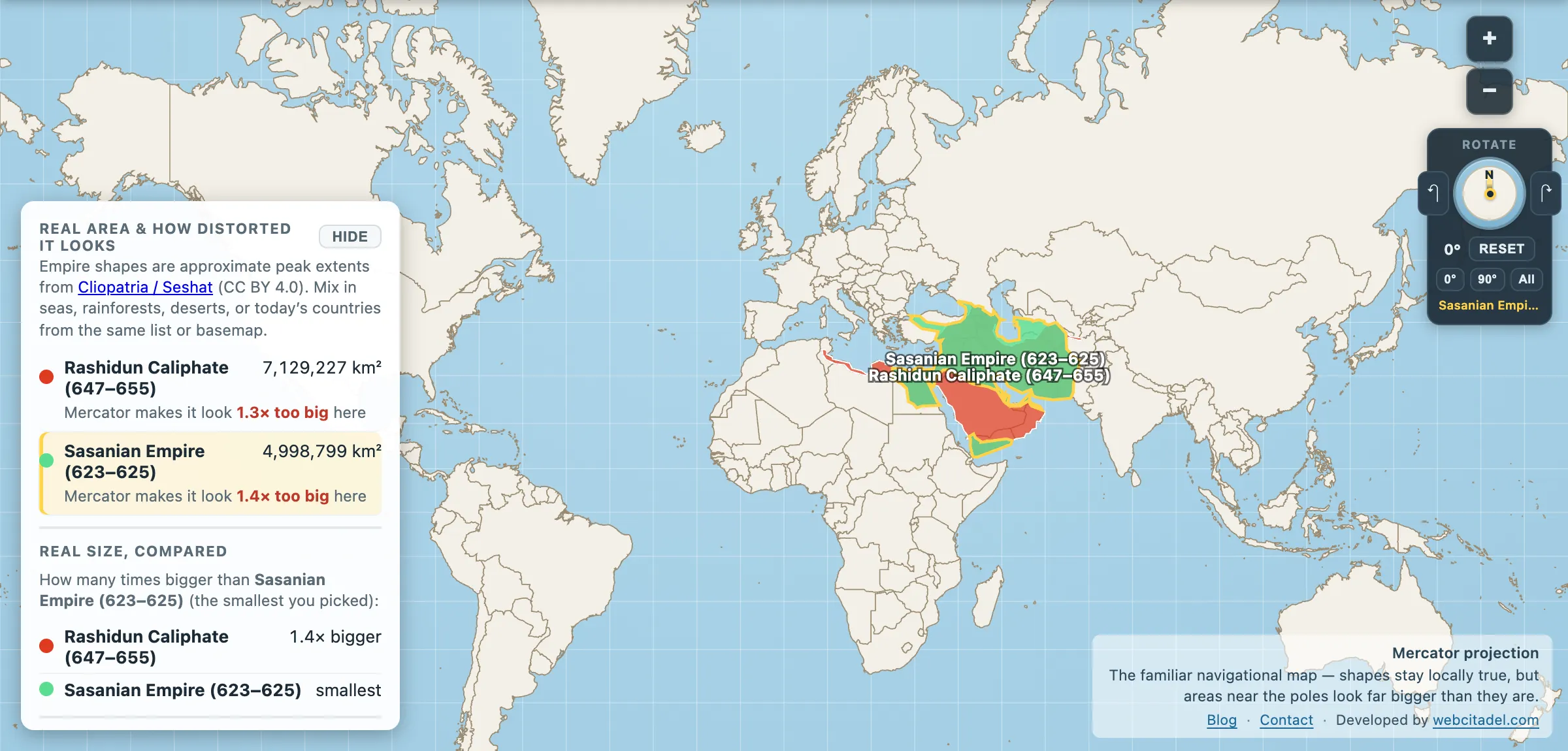
The same shapes on Mercator — the projection almost every map you see uses. Watch what it does to anything far from the equator.
Sources & methodology
- Empire extents: Cliopatria (Seshat Global History Databank), CC BY 4.0, as used in Map Real Size. Cross-checked against the conventional peak-extent figures used in Map Real Size’s quiz: the Rashidun–Sasanian ordering, and the order-of-magnitude pace, hold under both. Peak extents for the early caliphates are reconstructions from historical sources; the distinction between raided, tributary and administered territory is genuinely blurry in this period.
- The per-year figure divides the dataset’s peak extent by the 632–661 Rashidun period and is a rhetorical average, not a claim about any specific year.
- United Kingdom: country area in the app (239,619 km²).