
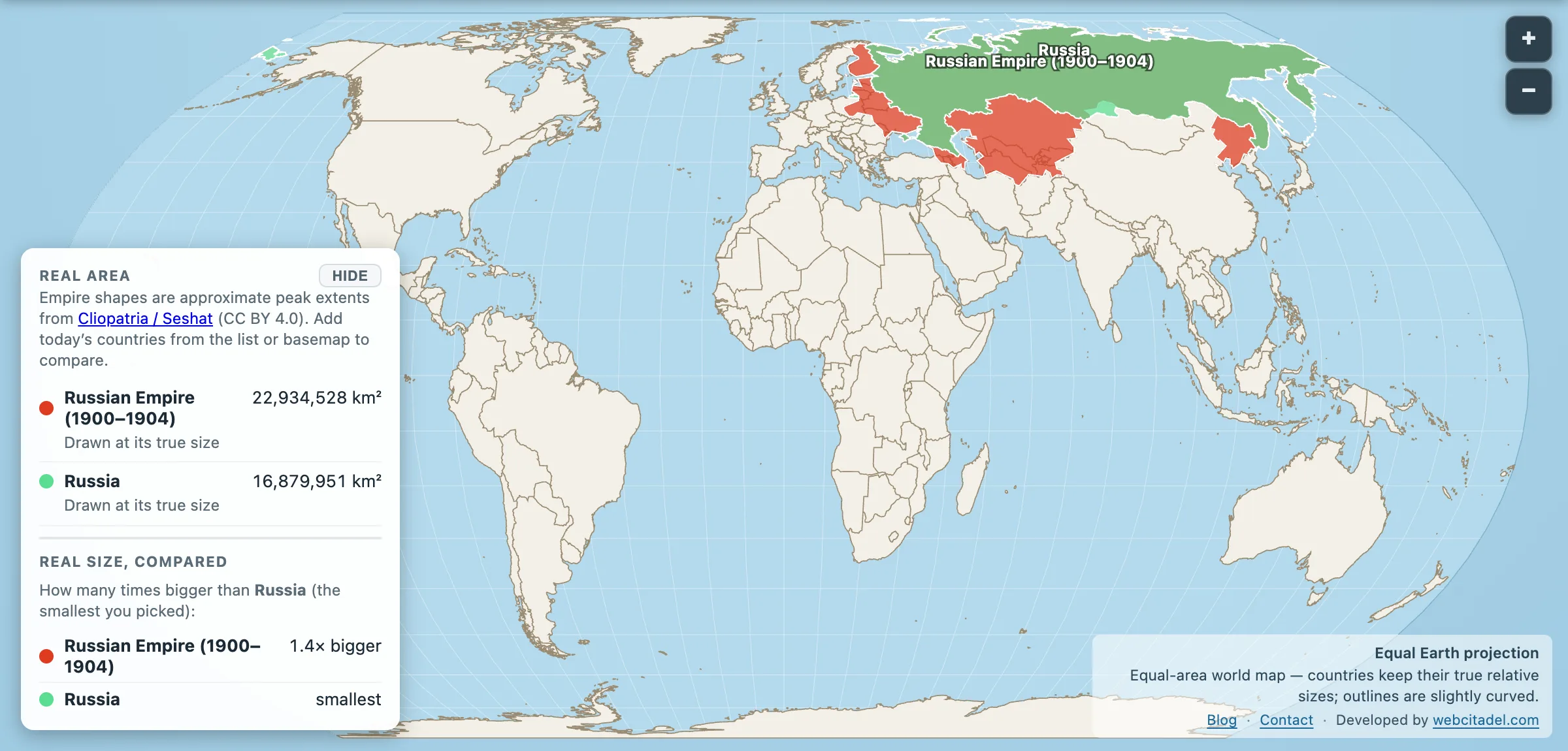
Modern Russia is the largest country on Earth, about 17.1 million km² of it, and nothing else is close. It feels like the ceiling. It isn’t. It’s the remnant.
Russian Empire at its peak, around 1900: 22,934,528 km².
That’s a third bigger than today’s Russia. The difference, nearly six million square kilometres, is more land than the entire European Union. It’s the third largest empire ever measured, behind only the British and the Mongols, and it covered about a sixth of all land on the planet.
Where the six million went
The empire’s roll call reads like a map of the twentieth century’s headlines. Finland, then a Grand Duchy of the tsar. Most of Poland. The Baltic states. Ukraine, Belarus, the Caucasus. The whole of Central Asia down to the Afghan border, five modern republics’ worth.
And, until 1867, Alaska. The tsar sold it to the United States for 7.2 million dollars, which works out to about two cents an acre, a price that has been physically painful for Russians to think about since roughly the Klondike gold rush. It remains the only time the empire’s territory changed hands over a till rather than a battlefield.
The strangest part: the Soviet Union nearly got the band back together. At 22.4 million km² it came within about half a million square kilometres of the imperial peak. Then 1991 happened and fourteen republics walked out the door, and the map lost more territory in one year than most empires ever held.
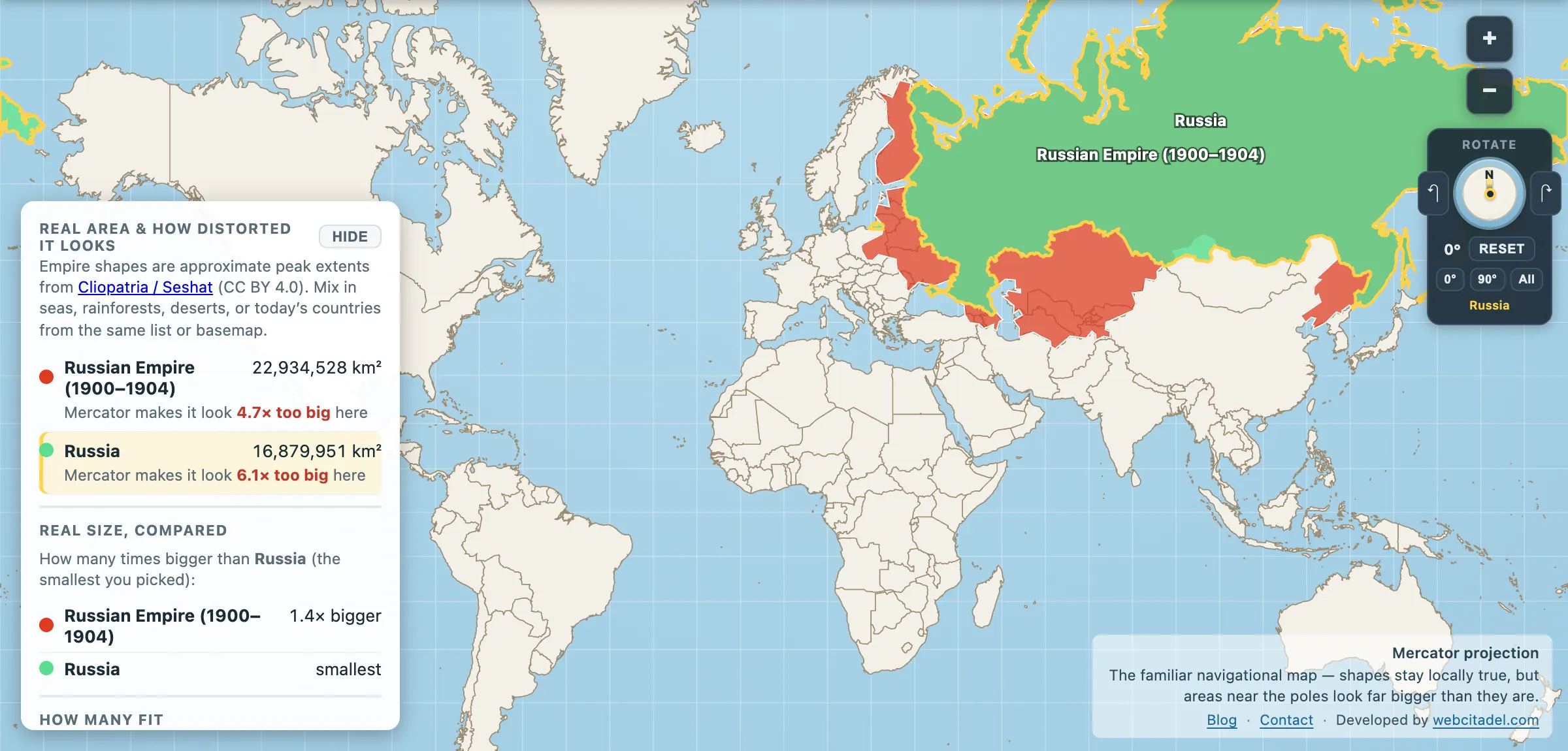
The same shapes on Mercator — the projection almost every map you see uses. Watch what it does to anything far from the equator.
Watch a century evaporate
Open the scene. The empire at its 1900 footprint and modern Russia, stacked on one equal-area map. The overlap is the story. Today’s giant sits inside its ancestor with sky visible all round the edges, west through Europe, south through Central Asia, east across the Bering Strait.
Drag the empire aside and park it over other places for scale. It covers Africa’s north half. It buries Australia three times over. The biggest country alive, and its own great-grandfather makes it look like a starter home.