
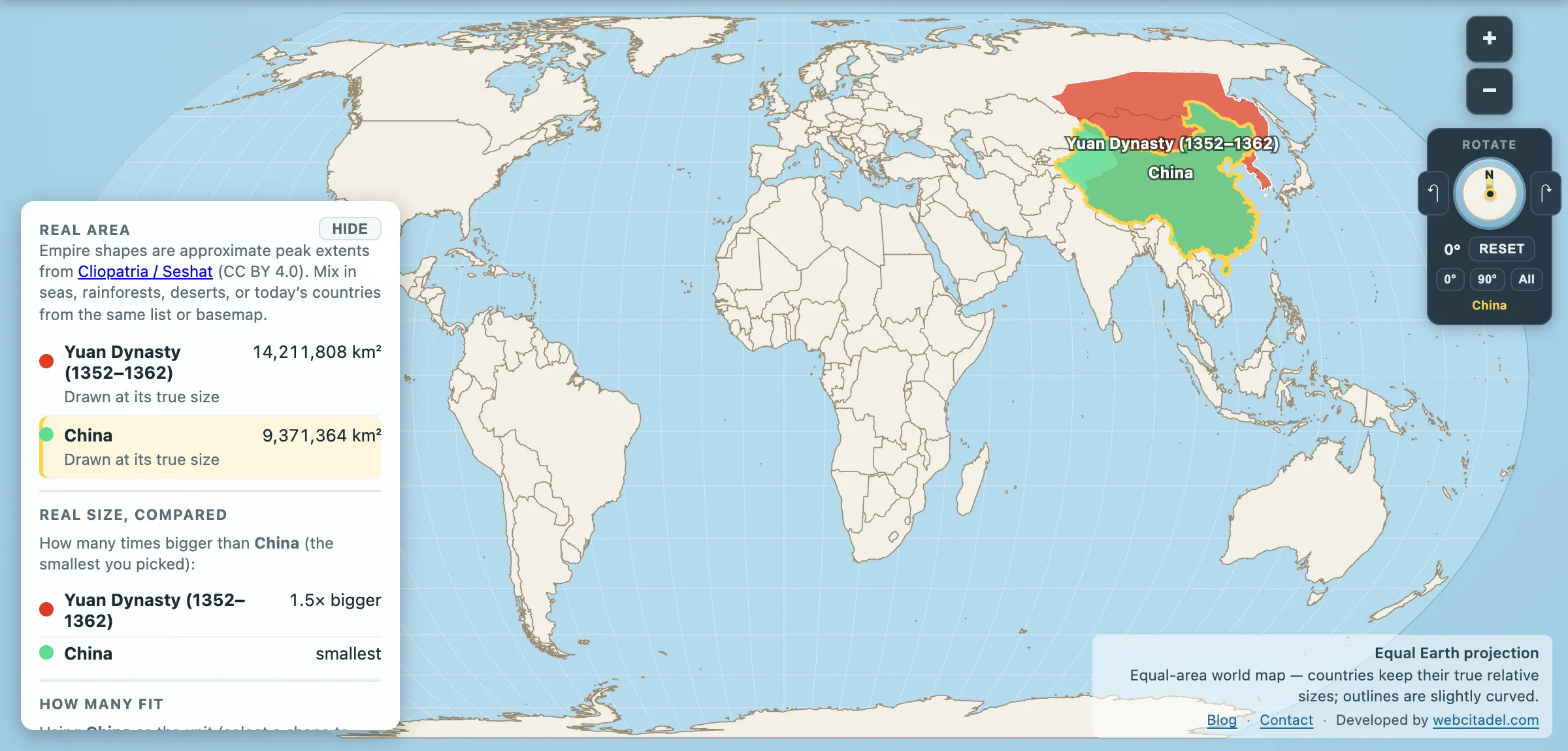
China has had a lot of dynasties and most of them get a chapter. The one that drew the biggest map tends to get an asterisk instead, because the emperor was Mongolian.
Yuan Dynasty as drawn here: 14,211,808 km². Modern China: 9,371,364 km².
That makes it half again the size of the country today, and bigger than Antarctica. The Yuan is generally reckoned the largest territory ever administered from a Chinese capital, and it was assembled by a grandson of Genghis Khan.
Two honest caveats before we go further, because this is one of the harder empires to pin a number on.
The figure depends heavily on the source. Estimates of the Yuan at its greatest extent run from about 11 million km² to around 13.7 million, largely because of one question: whether you count the other Mongol khanates’ nominal submission to the Yuan emperor as Great Khan. Count it and the empire balloons; don’t and it doesn’t. The 14.2 million above sits at the generous end.
And the shape you can drag is dated 1352–1362, which is not the peak. The Yuan’s maximum extent is conventionally placed at 1310, under Emperor Wuzong, after the Yuan and the Chagatai Khanate carved up the Ögedei Khanate between them. By the 1350s the dynasty was coming apart — the Red Turban Rebellion began in 1351 and the Yuan fell in 1368.
So take the ranking with care. Against the Qing’s 12.5 million km², the Yuan wins comfortably on the higher estimates and loses on the lower ones. What isn’t in dispute is that both were substantially larger than China today.
The empire inside the empire
The Yuan was the eastern portion of the Mongol world, which by then had fractured into khanates that fought each other as enthusiastically as they’d fought anyone else. Kublai Khan took the eastern share, finished off the Southern Song by 1279, and did something his grandfather would have found strange: he settled down and became a Chinese emperor.
He declared the dynasty in 1271 with a name lifted from the Book of Changes, moved the capital to Dadu — today’s Beijing, and the reason Beijing is the capital at all — and adopted the machinery of Chinese imperial government while keeping Mongols and Central Asians at the top of a four-tier social ranking that put southern Chinese at the bottom.
That combination is the whole Yuan in one sentence. A Chinese state by administration, a Mongol one by ownership, and never quite reconciled about it.
Paper money, Marco Polo, and a wind
Three things the Yuan is worth remembering for, beyond the map:
It made paper money the only money. China had had paper currency since the Song dynasty’s jiaozi two centuries earlier, but that began as merchants’ notes redeemable for coin and stayed regional. From 1271 the Yuan made its Chao the sole legal tender across the empire — taxes paid in it, private trade conducted in it, an entire economy running on paper by decree.
It worked for decades. Then, as governments have rediscovered repeatedly over the seven hundred years since, it stopped: the notes were printed to cover military spending until the inflation was serious enough to hollow out the dynasty’s authority. Marco Polo, describing the system for European readers who found it frankly implausible, was watching a monetary experiment centuries ahead of anything in Europe.
It reopened the road. The Mongol peace made overland Eurasian travel viable in a way it hadn’t been for centuries, which is why a Venetian merchant’s account of the Yuan court exists at all — and why the plague, a century later, could travel the same road.
And it lost to weather, twice. Kublai launched invasions of Japan in 1274 and 1281, the second with a fleet of a scale that beggars belief for the period. Both were broken up by typhoons. The Japanese called the storms kamikaze — divine wind — a phrase that would be borrowed for a different purpose in a different war.
The rest of the family
The Yuan is enormous and it’s still only a slice. The undivided Mongol Empire reached 27,388,749 km², nearly double the Yuan and second only to the British. That’s the empire that made modern Russia look small and came within a Germany of taking the all-time record.
And it’s not the only China that outgrew the modern one — the Qing were a third bigger than the People’s Republic, without any Mongol help at all.
See the biggest China
Open the Yuan with modern China on an equal-area map. China today sits inside the Yuan outline with Mongolia, big stretches of Siberia and the Tibetan plateau margins left over.
Drag the modern country around inside its own maximum. There’s a lot of room in there.
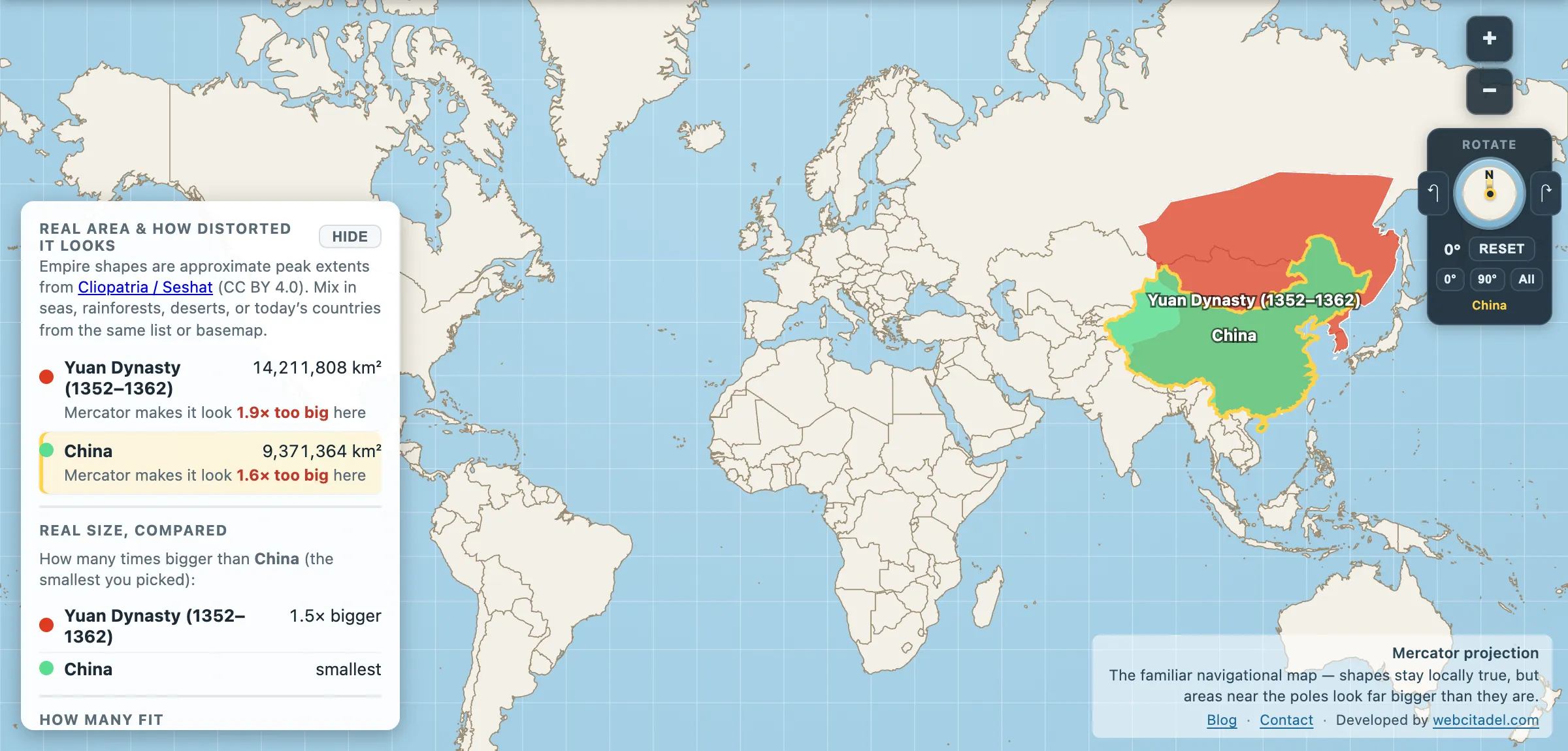
The same shapes on Mercator — the projection almost every map you see uses. Watch what it does to anything far from the equator.
Sources & methodology
- Empire extents: Cliopatria (Seshat Global History Databank), CC BY 4.0, as used in Map Real Size. The Yuan is the weakest peak-extent figure in this dataset. Its window (1352–1362) falls after the Red Turban Rebellion had begun, not at the dynasty’s maximum, which is conventionally dated to 1310 under Emperor Wuzong. Published estimates for that maximum range from about 11 million km² (Taagepera’s widely used series) to around 13.7 million, the difference turning largely on whether the other khanates’ nominal submission to the Great Khan is counted. The 14.21 million km² polygon here sits above that range. Treat the Yuan-versus-Qing ordering as source-dependent rather than settled.
- China: country area in the app (9,371,364 km²).
- Paper currency, the Japanese invasions and the Dadu capital are standard dynastic history; Marco Polo’s account is a contested but widely used source.