
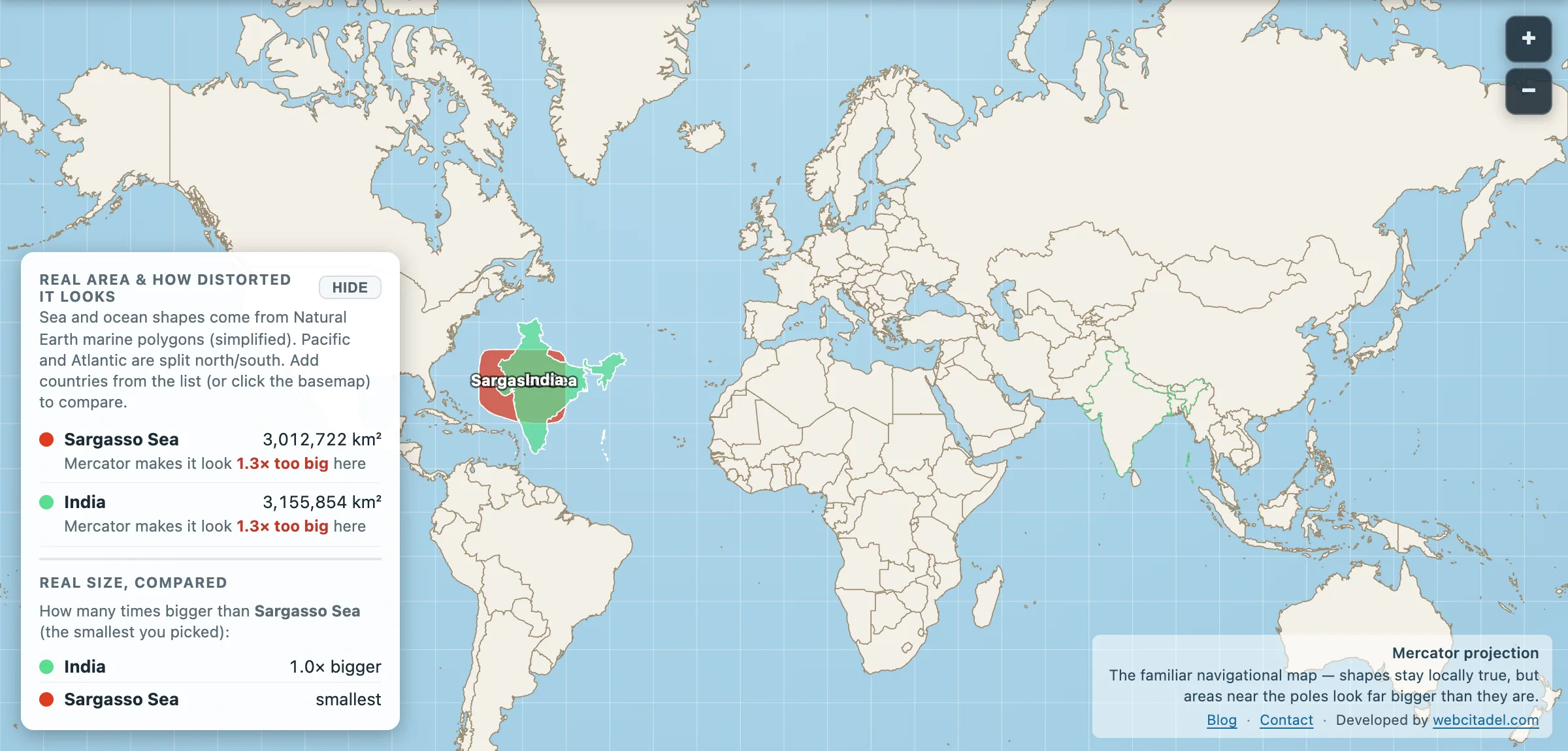
Every sea you can name has a shore. The Med has beaches, the Caribbean has islands, the North Sea has oil rigs and regret. Then there’s the Sargasso Sea, which touches no land at all. Its borders are four ocean currents, the Gulf Stream to the west, the North Atlantic Current up top, the Canary Current to the east and the North Atlantic Equatorial Current below, all rotating clockwise around a patch of the Atlantic like a fence made of moving water.
Inside that fence: 3,012,722 km² of unusually calm, unusually clear, deep blue sea. Almost exactly the size of India. The only land anywhere inside it is Bermuda.
The strangest CV in the ocean
- It’s named after sargassum, the free-floating seaweed that mats its surface and hosts an entire ecosystem, crabs, shrimp, baby turtles, found nowhere else quite like it.
- Columbus sailed through it in 1492 and his crew, spooked by weed thick enough to slow the ships, started the legend of a sea that traps vessels forever.
- Both the European and American eel spawn there and nowhere else, then drift thousands of kilometres to rivers on two continents. Where eels came from baffled everyone from Aristotle onwards. A young Sigmund Freud dissected 400 eels in 1876 trying to find their reproductive organs and failed, because eels don’t develop them until their final journey. No human has ever witnessed them spawning in the wild. Scientists only tracked adult eels all the way to the Sargasso in 2022.
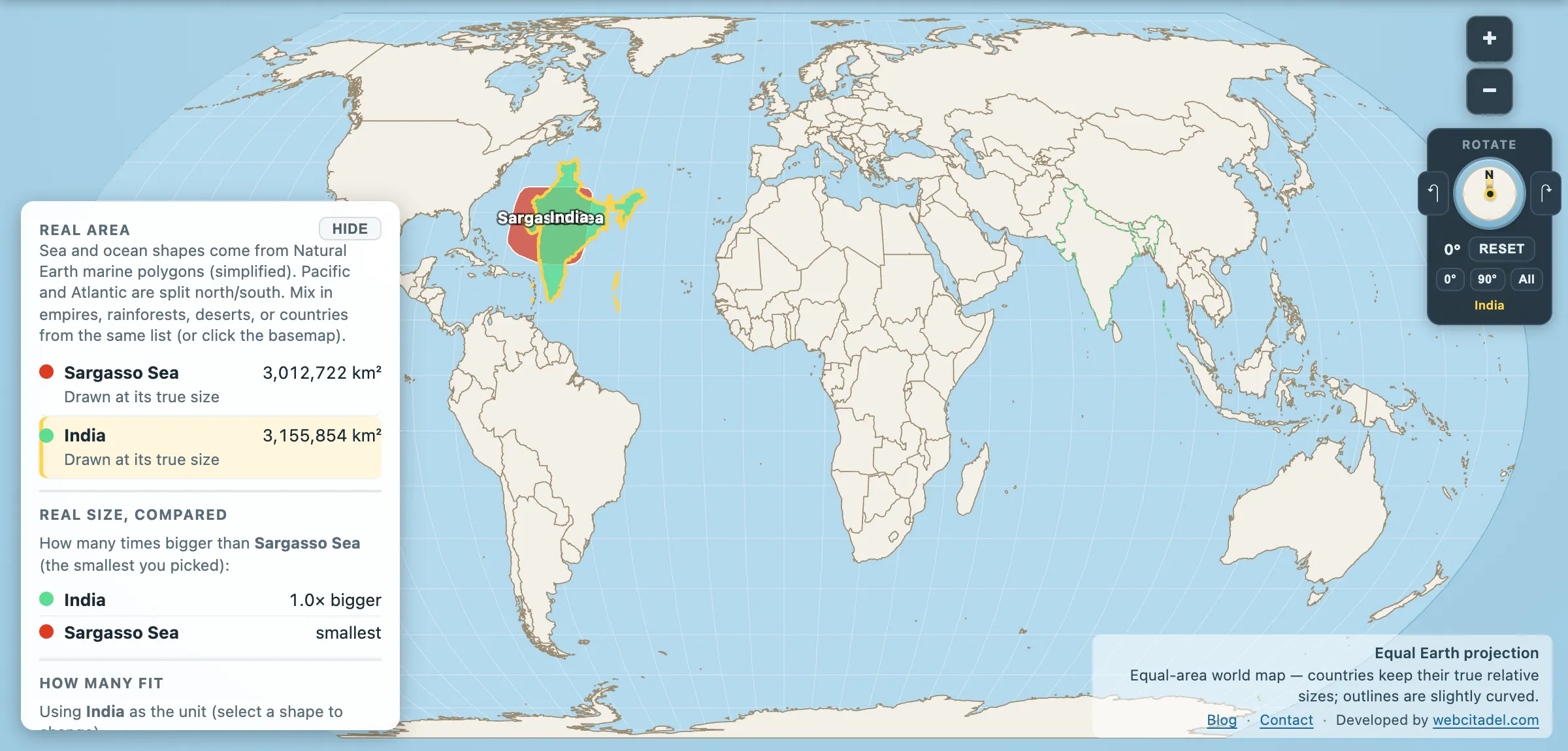
The same shapes on Equal Earth, where every square kilometre is drawn the same size wherever it sits. This is the honest version.
Drop a subcontinent on it
Open the scene and India is already parked on top of the Sargasso. The fit is almost eerie, a billion-person country matched by a sea most people have never located. Drag India off and the sea keeps its shape, because this one isn’t drawn by coastlines. It’s drawn by physics.
And it’s still not the biggest sea going. That title belongs to the Philippine Sea, which out-areas the Roman Empire. The ocean has been keeping better secrets than the land your whole life.