
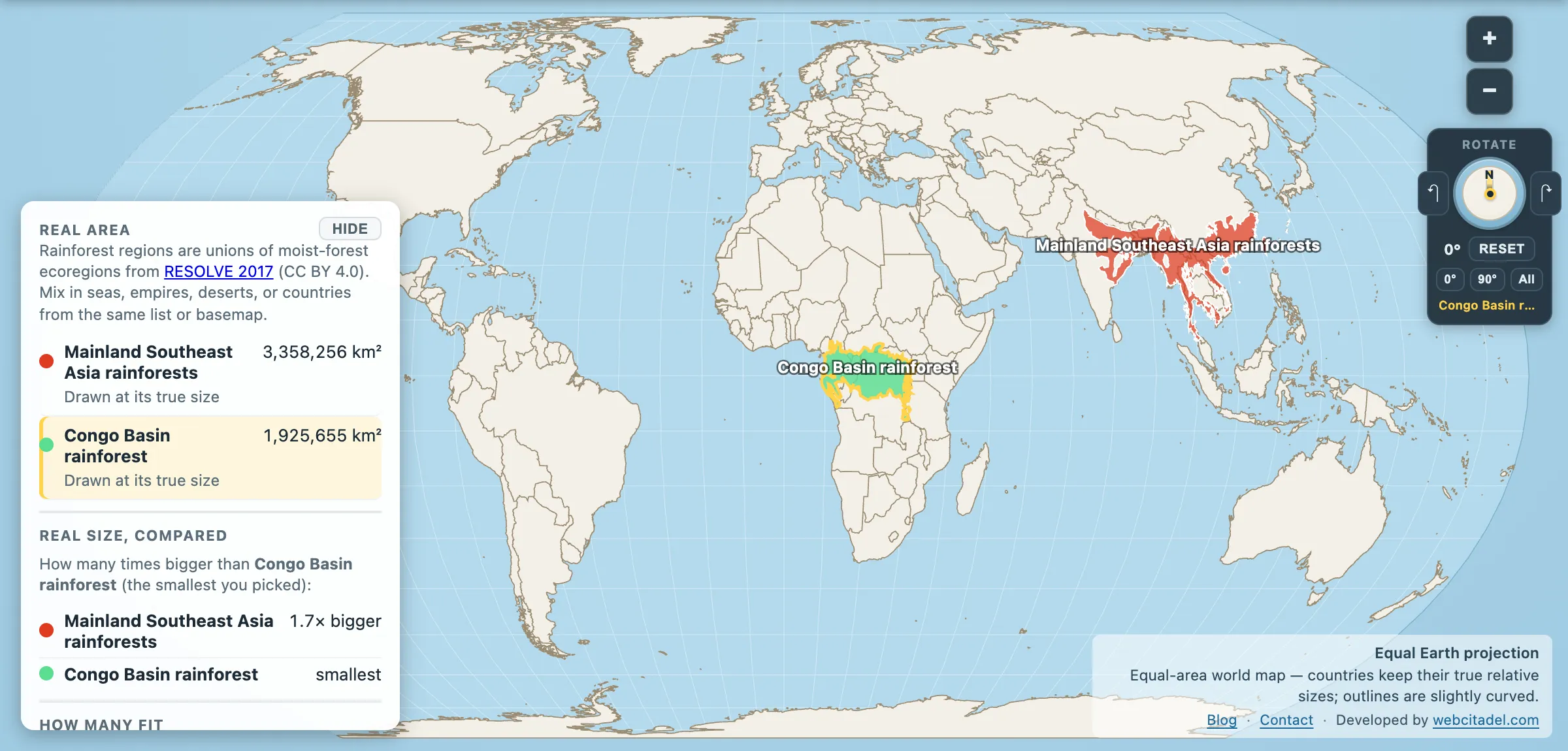
Name the world’s great rainforests. You’ll get the Amazon first, every time. Then the Congo. Then, usually, a pause, and someone says “Borneo?”
In Map Real Size’s rainforest catalog, the region between the Amazon and the Congo is neither of those:
- Amazon rainforest: 6,815,645 km²
- Mainland Southeast Asia rainforests: 3,358,256 km²
- Congo Basin rainforest: 1,925,655 km²
Southeast Asia’s mainland moist forests come to 1.7 times the Congo Basin, and about half the Amazon. Second place, by a clear margin, with no name anyone uses.
That last part is the reason for the anonymity. The Amazon is one forest with one name. The Congo is one basin with one river. This is a region — moist forest ecoregions stretching across Myanmar, Thailand, Laos, Cambodia, Vietnam and into southern China and north-east India, spanning half a dozen countries, several mountain ranges and no single unifying label. Nothing to put on a poster.
The forest that keeps producing new large animals
There is a working assumption that the age of discovering big mammals ended somewhere around the Victorians. The Annamite Range, along the Laos–Vietnam border, did not get the memo.
In 1992 a joint Vietnamese–WWF survey in Vu Quang, near the Laos border, found a skull with long straight horns in a hunter’s house. It turned out to belong to the saola — a bovine so distinct it required a new genus, and the first large mammal new to science in more than fifty years. It was formally described in 1993.
It is sometimes called the Asian unicorn, mostly because almost nobody has seen one. No scientist has confirmed a sighting in the wild for years; the species is known largely from camera traps, village specimens and hair. It may already be gone. And it was found not in some untouched wilderness but in a part of the world people had been mapping, logging and fighting over for a century.
The same range has produced several deer species new to science over the same period, plus a striped rabbit, plus a steady stream of reptiles and amphibians. This is what a large, mountainous, historically inaccessible forest does: it keeps things.
Why nobody counts it as one thing
The region’s forests are structurally different from the Amazon’s, and that’s part of why they read as fragments rather than a mass. The monsoon gives much of mainland Southeast Asia a genuine dry season, so alongside evergreen rainforest you get monsoon forest that drops its leaves — teak country, dry dipterocarp woodland, a mosaic rather than an unbroken green sheet.
It is also among the most fragmented and most pressured forest on Earth. Logging, rubber and cassava plantations, hydropower on the Mekong tributaries, road-building and one of the world’s most intense wildlife trafficking networks all converge here. Conservation biologists have used the phrase “empty forest syndrome” for parts of it: canopy intact from a satellite, snare lines underneath, and very little left that moves.
The Mekong runs through the middle of it — 4,900 km from the Tibetan plateau to the South China Sea, a river whose fishery feeds tens of millions and whose flood pulse reverses the flow of a Cambodian lake twice a year.
Stand it next to the Congo
Open Southeast Asia’s rainforests with the Congo Basin on an equal-area map. Drag one onto the other. The Congo — the forest everyone lists second — disappears inside it with room to spare.
Then bring in the Amazon, which we’ve already measured against the Congo, and see where all three actually sit.
For the island forests next door, see Sundaland.
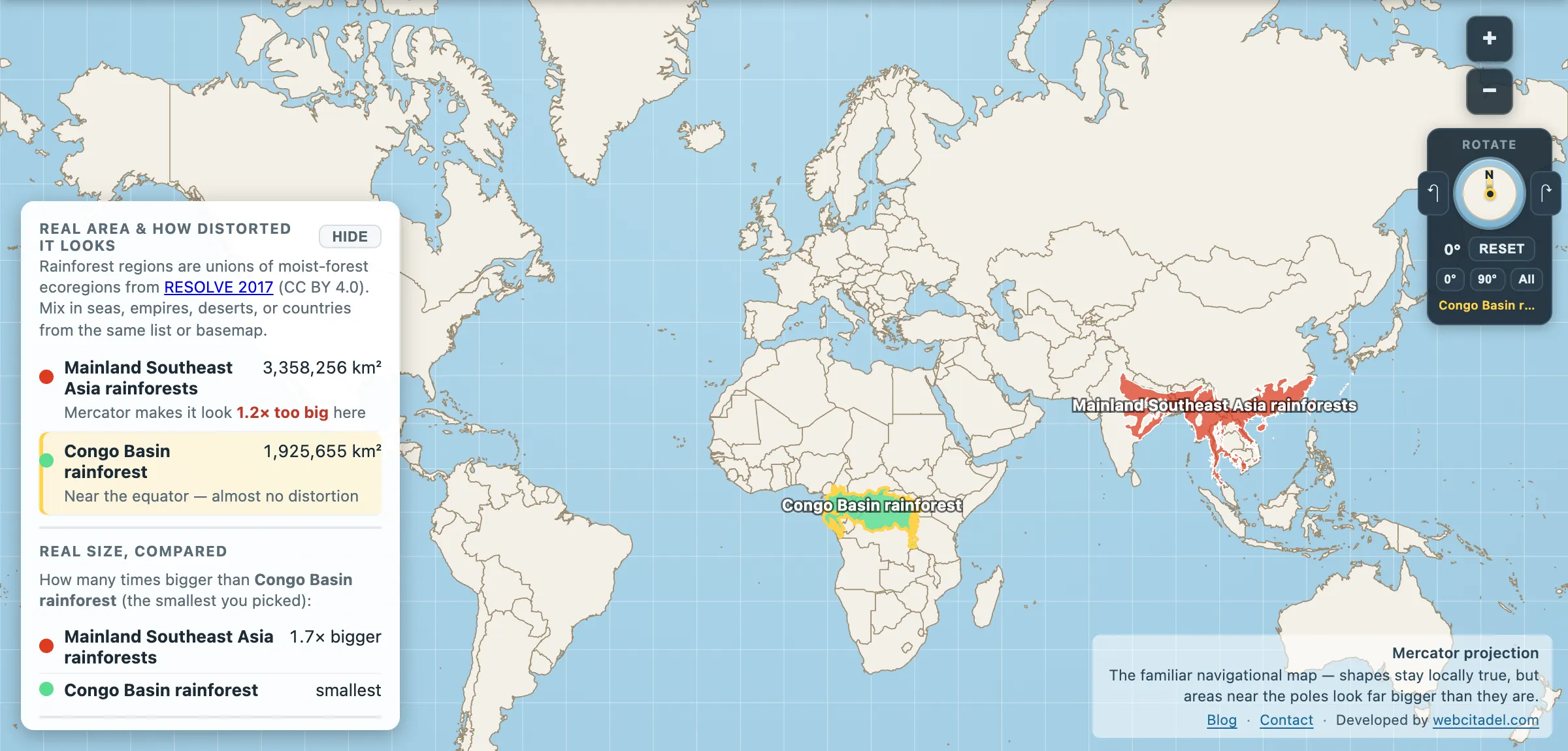
The same shapes on Mercator — the projection almost every map you see uses. Watch what it does to anything far from the equator.
Sources & methodology
- Rainforest regions are unions of moist-forest ecoregions from RESOLVE 2017 (CC BY 4.0), as used in Map Real Size. These are ecoregion boundaries, not current canopy cover — much of the area inside them has been cleared, and the polygon shows where this forest type belongs, not where it survives.
- That caveat matters more here than almost anywhere else, given the region’s deforestation rate.
- The saola’s discovery and status are as documented by IUCN and the survey literature.