
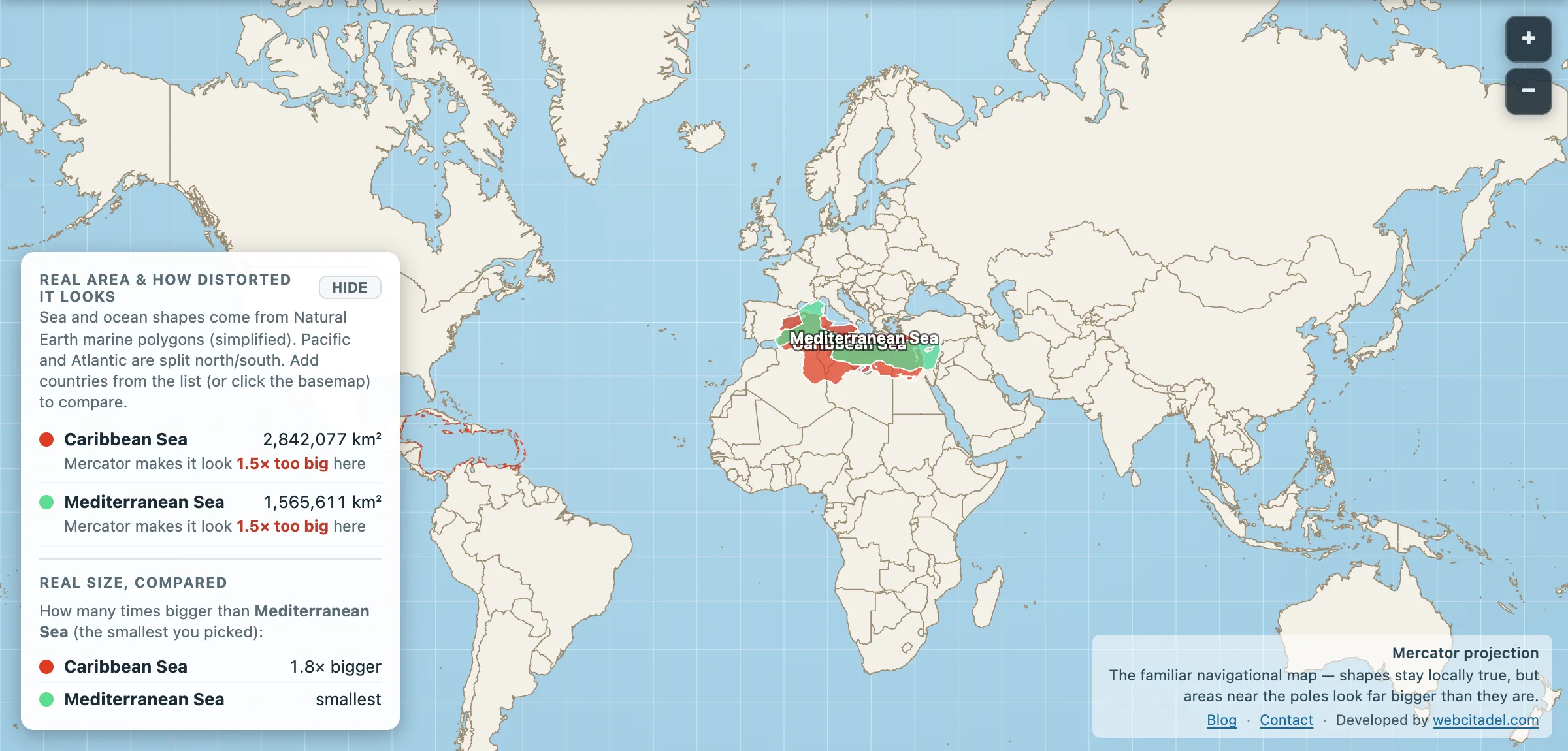
Two famous seas. One invented the beach holiday, the other perfected it. The Mediterranean has five thousand years of civilisation on its shores, twenty-one countries around its rim and more history per kilometre of coast than anywhere on Earth. The Caribbean has reggae, rum and a reputation for being a collection of small islands.
Now the tape measure.
Caribbean Sea: 2,842,077 km². Mediterranean Sea: 1,565,611 km².
The Caribbean is not far off twice the size. The sea your brain files under “island chain” out-areas the sea it files under “cradle of civilisation” by one and a quarter million square kilometres, which is roughly two Frances of extra water.
Depth check
It’s not just wider. It’s deeper, top to bottom:
- The Mediterranean averages about 1,500 metres. The Caribbean averages over 2,200.
- The Med’s deepest point, Calypso Deep off Greece, bottoms out around 5,200 metres. The Caribbean’s Cayman Trough drops past 7,600, the deepest water anywhere between North and South America.
- The region holds around 7,000 islands, islets and cays, plus the Mesoamerican Reef, at about 1,000 km the longest barrier reef in the western hemisphere.
The Med gets one consolation prize and it’s a beauty: it once dried up entirely and refilled in a geological instant, which the Caribbean has never managed.
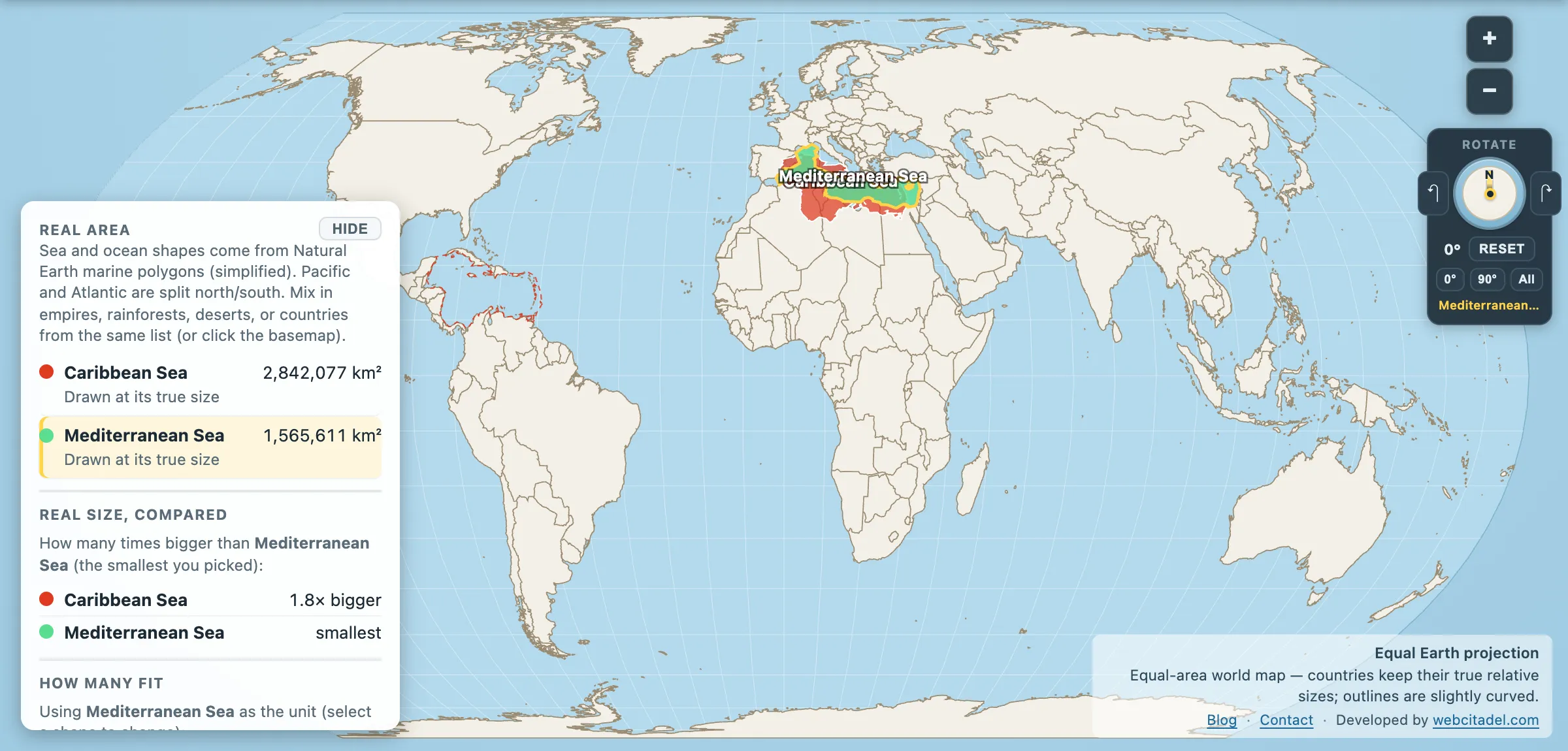
The same shapes on Equal Earth, where every square kilometre is drawn the same size wherever it sits. This is the honest version.
Swap continents
Open the scene and the Caribbean has already been dragged across the Atlantic and laid over Europe’s sea. The Med vanishes underneath with Caribbean water left over spilling across Spain, Italy and half the Balkans.
Why did you have it backwards? Partly branding, partly the usual projection politics. The Med sits ten degrees further north, wears a small Mercator boost and gets drawn in loving detail on Europe-centred maps, while the Caribbean is usually a corner decoration on maps of somewhere else. Measured honestly, the corner decoration is the giant.