
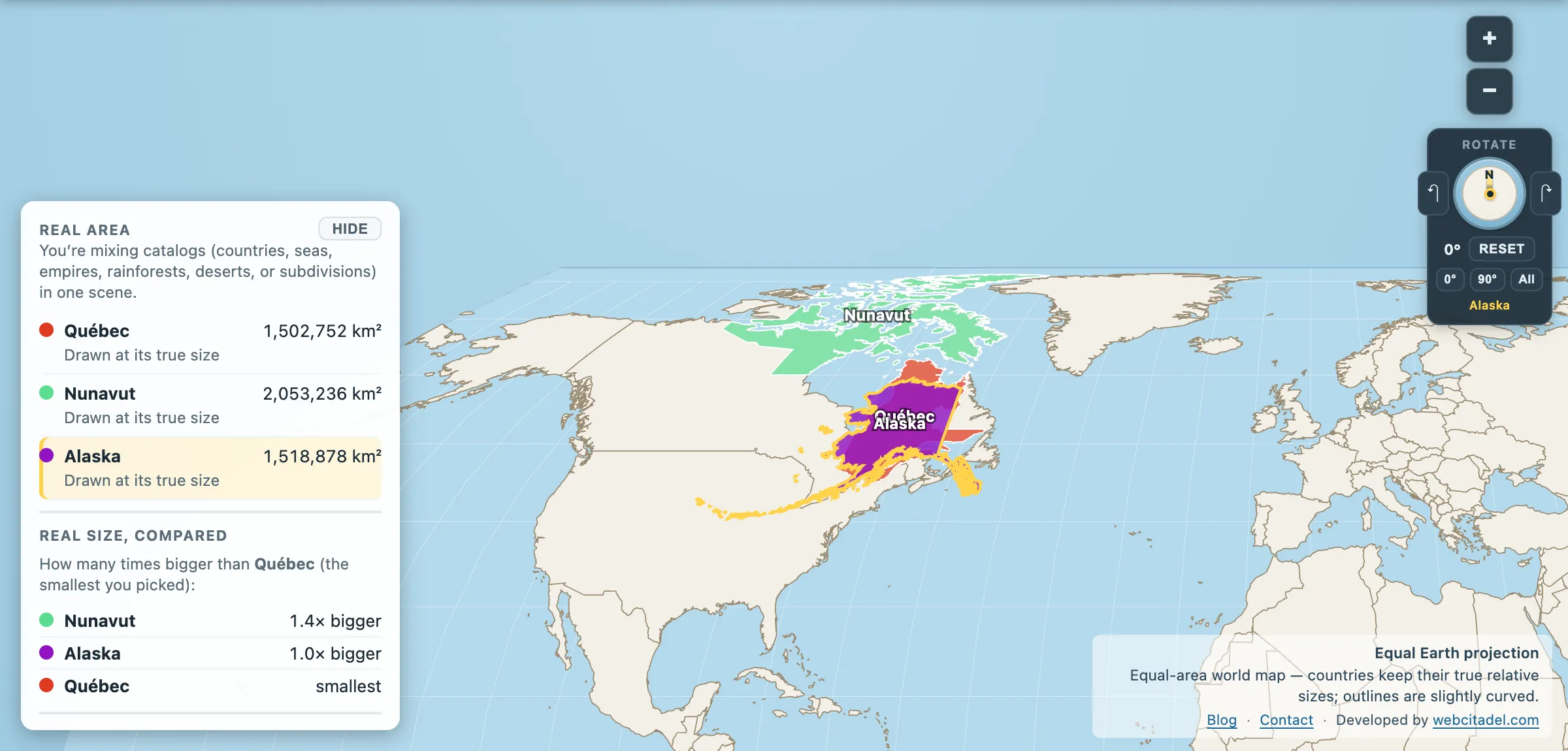
Alaska is the American benchmark for enormous. It has its own bragging-rights fixture against Texas, which it wins by a factor of more than two.
Take it across the border and the fixture gets much closer.
- Alaska: 1,518,878 km²
- Québec: 1,502,752 km²
Alaska wins by about 16,000 km² — the size of Hawaii — out of more than a million and a half. On a map that’s a rounding error.
All three outlines are on Quebec vs Alaska.
And then there’s the province neither of them mentions.
- Nunavut: 2,053,236 km²
Nunavut is bigger than both, by a wide margin. It is larger than Mexico, larger than Saudi Arabia, and within a whisker of Greenland — 95 per cent of it, and Greenland is the shape this whole site keeps having to cut down to size. Nunavut’s population is around 40,000 people.
The emptiest big place on Earth
That works out at roughly one person per fifty square kilometres, which is among the lowest population densities of any administrative division anywhere. There are no roads connecting Nunavut’s communities to each other or to the rest of Canada. Everything arrives by air or, in the short ice-free window, by sea.
Nunavut is also the newest part of Canada’s map. It was created on 1 April 1999, split out of the Northwest Territories following the largest Indigenous land claim settlement in Canadian history. The name means “our land” in Inuktitut, and the territory has an Inuit majority — the reason it exists as a separate jurisdiction with its own government rather than as a region of somewhere else.
Its capital, Iqaluit, has a population you could fit in a football stand, and it administers an area larger than most countries in the world.
The other giants
Canada does not run short of these. Behind Nunavut and Québec come the Northwest Territories at 1,337,198 km², Ontario at 1,074,087 km² and British Columbia at 938,591 km² — a province larger than any country in Europe except Russia and Ukraine.
Québec’s own scale is easy to lose behind Montreal and Quebec City. North of the populated St Lawrence corridor is a vast expanse of Canadian Shield, taiga and tundra, including the James Bay hydroelectric complex — one of the largest such systems on the planet, generating power from rivers rerouted across an area the size of a country, on land that is Cree territory and was developed following a landmark 1975 agreement.
Both Québec and Alaska share a structural quirk with Nunavut: nearly all the people live in a small fraction of the area, and the map’s information about where anyone is comes almost entirely from the coastline.
Line them up
Open Québec and Nunavut with Alaska dragged over eastern Canada, on an equal-area map. Alaska and Québec overlap almost exactly. Then look north at Nunavut, which is a third bigger than either.
This is worth doing specifically on an equal-area projection, because on Mercator all three are at high latitude and all three are inflated together — the distortion cancels out visually and hides how big they genuinely are. Drag them to the equator with the app’s animate control and watch them shrink to their true size while Canada quietly stays larger than the United States.
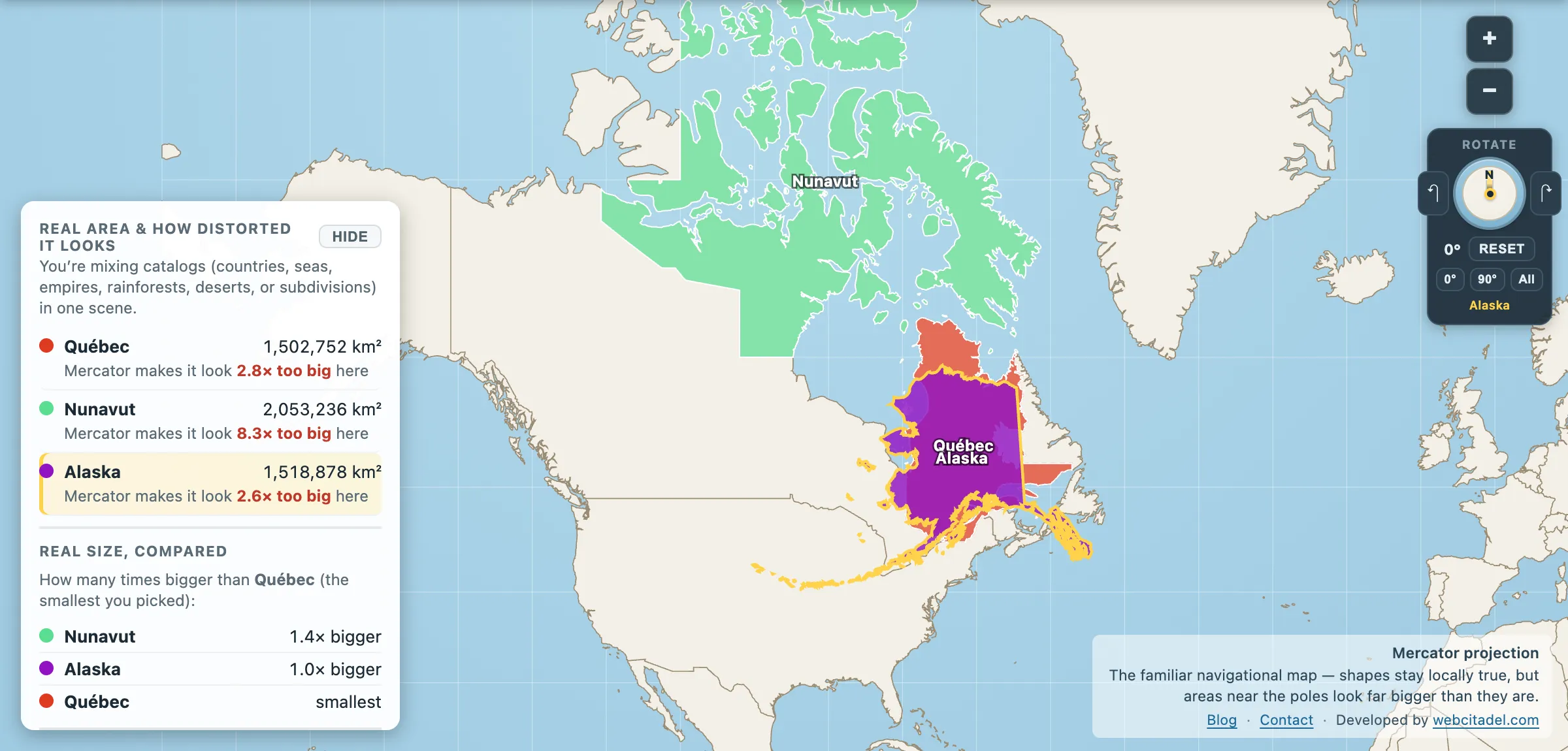
The same shapes on Mercator — the projection almost every map you see uses. Watch what it does to anything far from the equator.
Sources & methodology
- Provincial and state areas are computed from Natural Earth 1:50m states and provinces (Canada) and the US states dataset, as used in Map Real Size. Official Statistics Canada figures for Québec and Nunavut include large freshwater areas and differ slightly from these polygon areas.
- Population figures are approximate current estimates.
- The 1999 creation of Nunavut and the 1975 James Bay and Northern Quebec Agreement are matters of public record.