
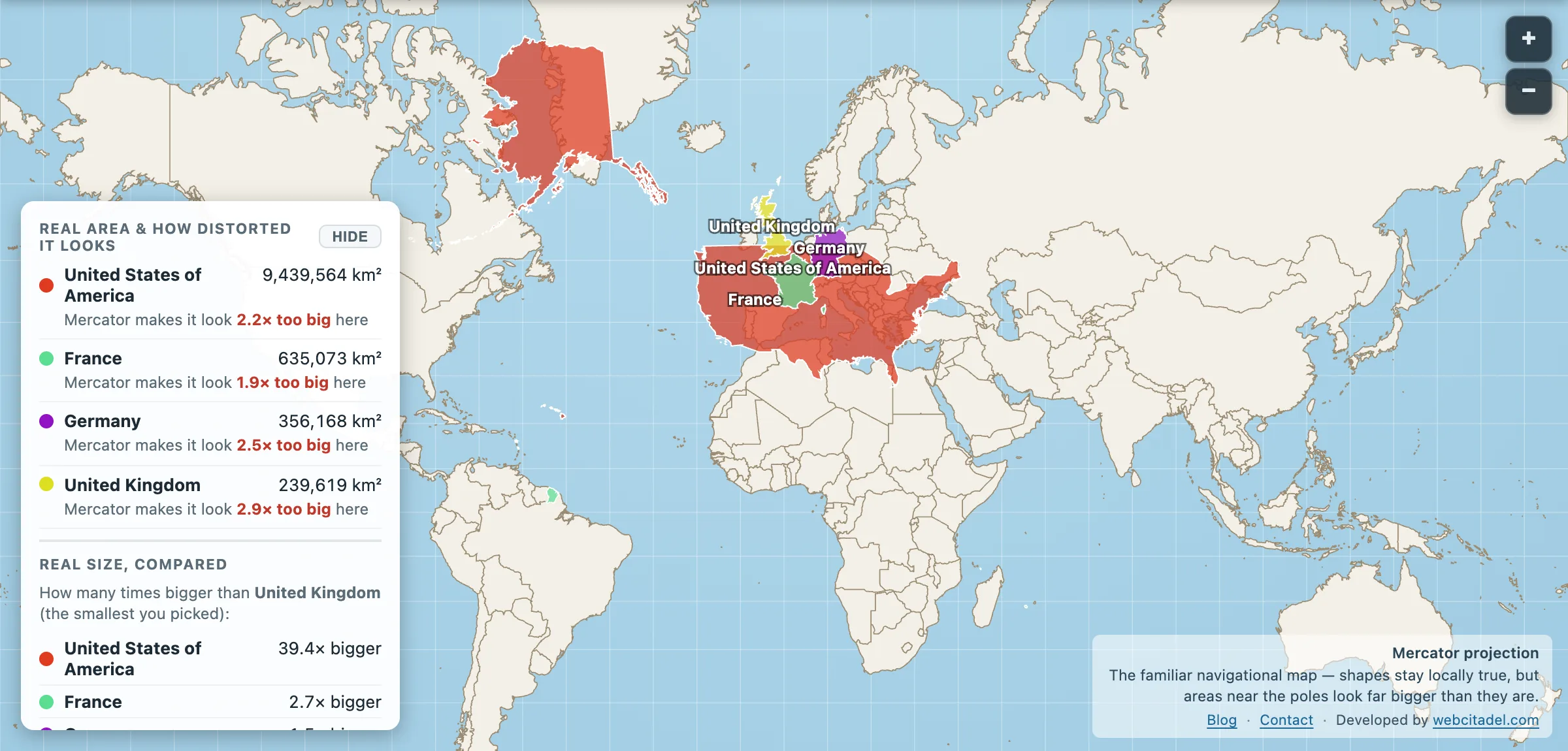
Pub question for a transatlantic table. Which is bigger, Texas or France?
France feels like the answer. It is the largest country in the EU, the hexagon that eats a corner of every European map, the place with the high-speed trains and the sense of scale. Texas is a state. States are subdivisions. Subdivisions are smaller. Everyone knows the hierarchy.
Texas: 688,751 km². France: 635,073 km².
Texas takes it. Not by a hair. By about Austria.
While you’re recalculating
- California: 409,774 km². Germany: 356,168 km². California wins.
- Montana: 379,793 km². Still bigger than Germany.
- The UK: 239,619 km². Roughly a third of Texas. One state, three United Kingdoms, change left over for Northern Ireland’s feelings.
This is the same shock as dropping the whole USA on Europe, just zoomed in to the state that won’t shut up about itself and discovering the brag was underselling.
Why Europe feels bigger than it measures
Density and history. France packs 68 million people and two thousand years of labelled places into that hexagon. Texas packs 30 million and a lot of sky. Your mental map tracks names, not hectares. Mercator also gives western Europe a mild northern boost, so the hexagon looks a little more sure of itself on the wall than it does on the globe.
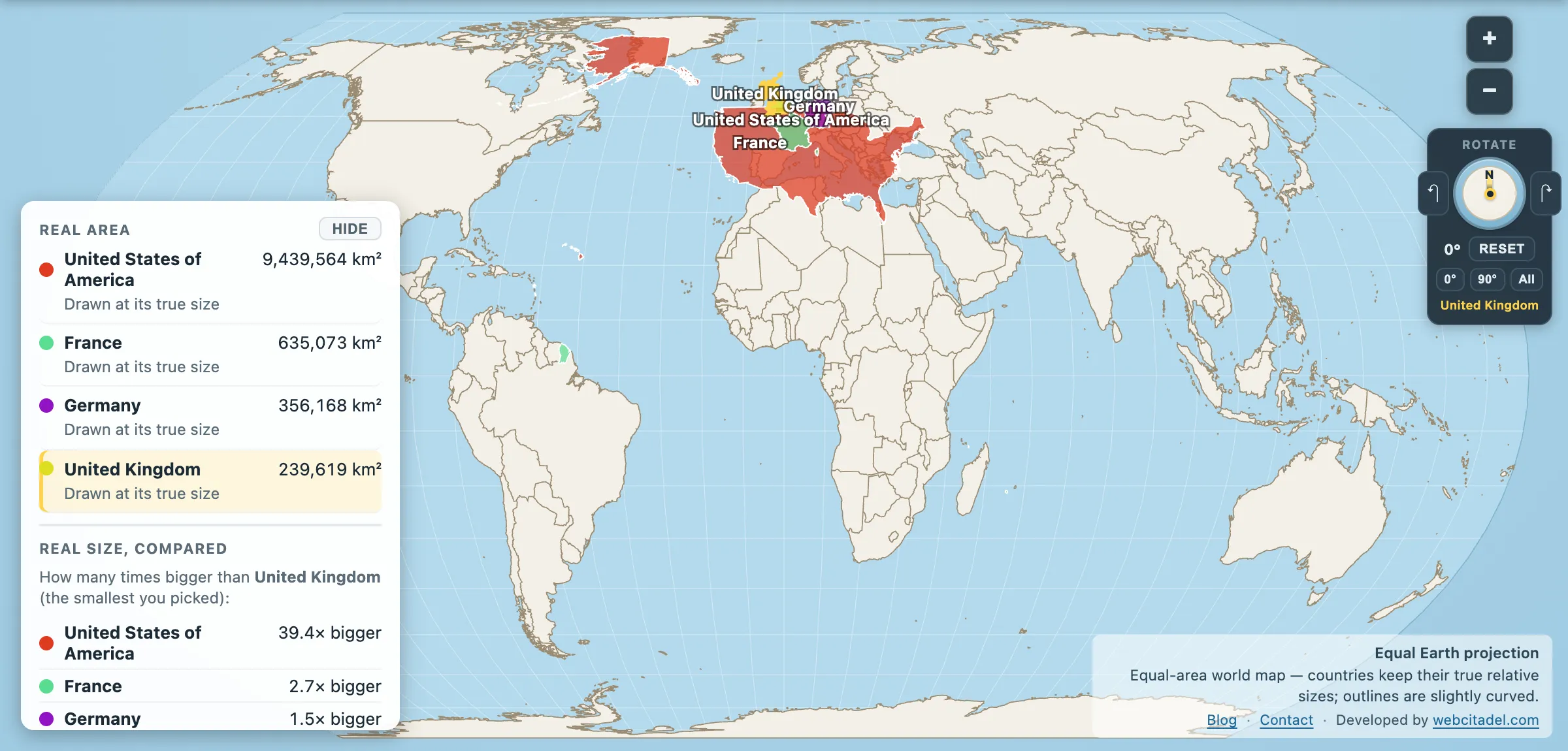
The same shapes on Equal Earth, where every square kilometre is drawn the same size wherever it sits. This is the honest version.
Overlay the receipts
Open the scene. The USA is already lying across Europe with France, Germany and the UK lit underneath. Find the Texas-sized bite of that outline. Then imagine peeling California off the west coast and dropping it on Germany.
States are not “small”. Some of them are European countries that forgot to get a seat at the UN.