
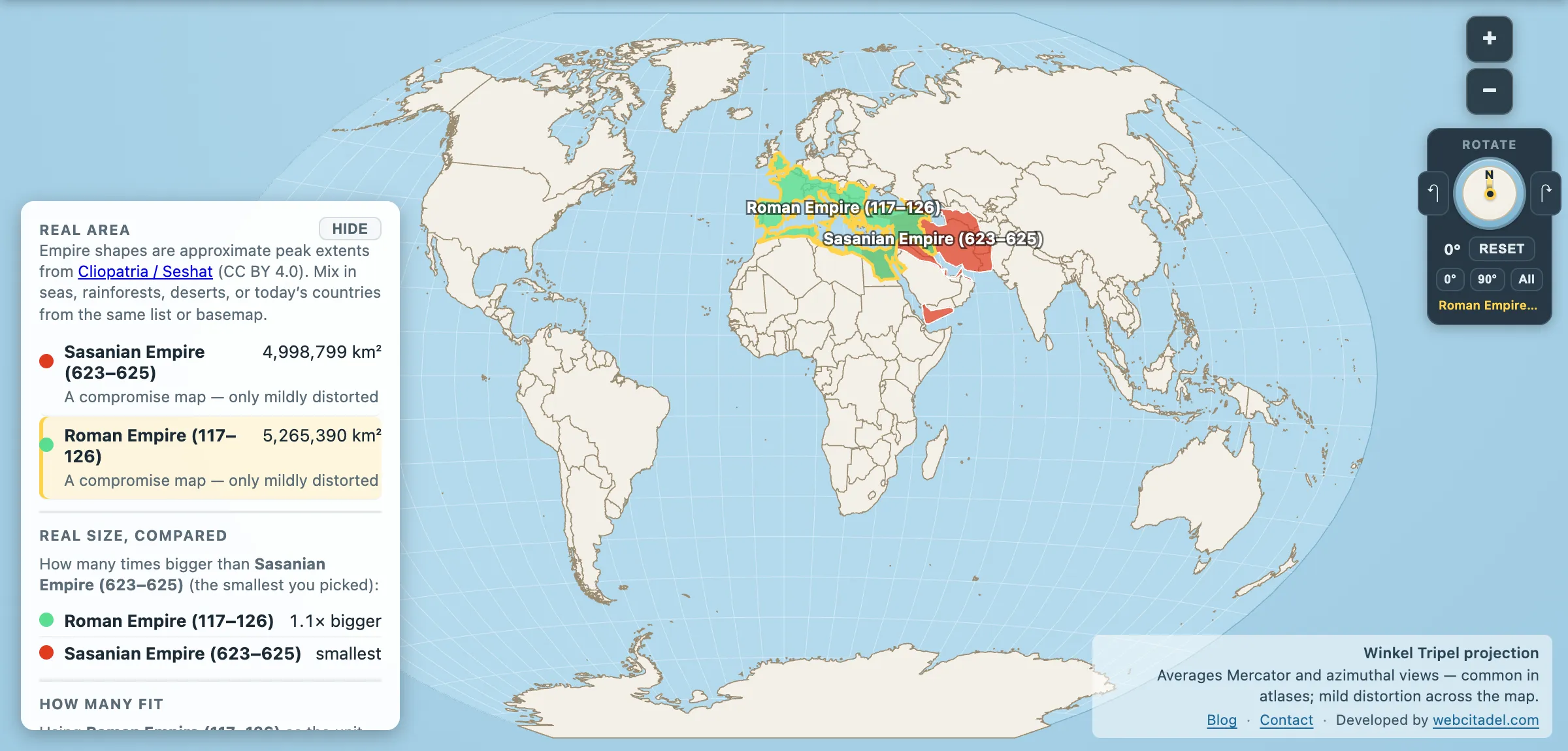
Ask for Rome’s great rival and you’ll get Carthage, which Rome erased in 146 BC and then spent two thousand years being congratulated for. The empire that actually held Rome to a draw for four centuries doesn’t come up.
- Roman Empire at its peak: 5,265,390 km²
- Sasanian Empire at its peak: 4,998,799 km²
Ninety-five per cent of Rome’s area. Not a rival in the sense of a difficult neighbour — a rival in the sense of a matched pair.
The Persia that came back
The Sasanians took over from the Parthians in 224 AD and explicitly presented themselves as the restoration of the Achaemenid Persia that Alexander had ended five and a half centuries earlier. They ran an empire from Mesopotamia to the Indus with a capital at Ctesiphon, a Zoroastrian state religion, a heavy-cavalry military tradition that Roman armies borrowed from, and a level of administrative and artistic sophistication that Byzantine writers grudgingly acknowledged by treating Persia as the only other real state on Earth.
The scoreboard between them is genuinely even, which is the part that gets lost. In 260 AD the emperor Valerian was captured alive by Shapur I — the only Roman emperor ever taken prisoner by a foreign power — an event Shapur had carved into a cliff face at Naqsh-e Rostam, where the relief of a Roman emperor kneeling is still there. Rome had its own successes and its own sackings of Ctesiphon. Neither side could finish it.
The war that ended both of them
Then, between 602 and 628, they tried properly.
The Sasanians under Khosrow II overran the Levant, took Jerusalem in 614 and carried off the relic of the True Cross, occupied Egypt, and reached the Bosphorus. It looked terminal for the Eastern Roman state. Then Heraclius, in one of the most improbable campaigns in military history, took an army around through the Caucasus into the Persian heartland and won at Nineveh in 627. Khosrow was overthrown and killed by his own court, and the Sasanian state fell into a succession crisis that ran through several rulers in a handful of years.
Both empires had spent twenty-six years and everything they had. The frontier returned to almost exactly where it had started, which is the war’s real epitaph.
Four years later, Arab armies arrived out of the south. Within twenty years the Sasanian Empire had ceased to exist — absorbed entirely by the Rashidun Caliphate — and Byzantium had lost Syria, Egypt and North Africa and would never be a first-rank power again.
Two superpowers of late antiquity, fighting each other to exhaustion at precisely the wrong moment. It is the clearest example in history of a war in which both sides lost.
Two shapes, one seam
Open the Sasanian Empire with Rome. Two shapes of near-identical size, meeting along a seam through Mesopotamia and Armenia — the most fought-over ground of the ancient world, and still contested territory in the modern one.
Note the two peaks are three centuries apart, so this isn’t a snapshot of one moment. It’s a comparison of maxima: what each empire was capable of holding at its best.
Rome is the empire in the room in every European history lesson. On the map it had a mirror, and the mirror lasted four hundred years.
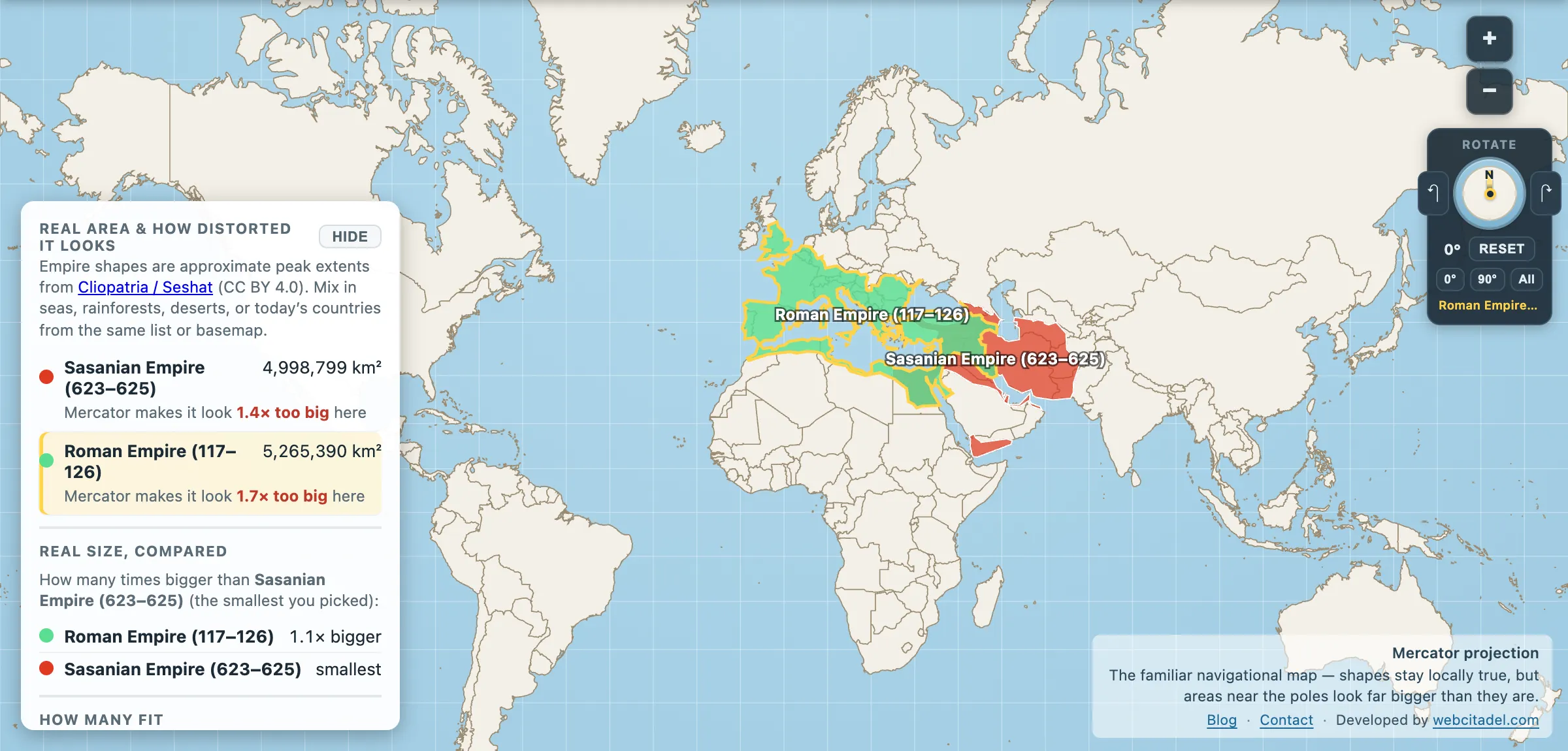
The same shapes on Mercator — the projection almost every map you see uses. Watch what it does to anything far from the equator.
Sources & methodology
- Empire extents: Cliopatria (Seshat Global History Databank), CC BY 4.0, as used in Map Real Size. The conventional figures used in Map Real Size’s quiz put Rome at about 5.0 million km² instead of 5.27, which brings the two empires closer still — the ‘matched pair’ reading survives both sources. The Sasanian window (623–625) captures the empire at its Khosrow II maximum including the occupied Roman provinces, which it held only briefly. The Roman window (117–126) is Trajan’s maximum. Comparing peaks means comparing two different centuries.
- Valerian’s capture, the 602–628 war and the Arab conquests are standard late-antique history.