
Deserts are supposed to be where nobody is. That’s the deal. Sand, silence, a skull, maybe a vulture with good comic timing. Empty is the whole brand.
Then there’s the Thar.
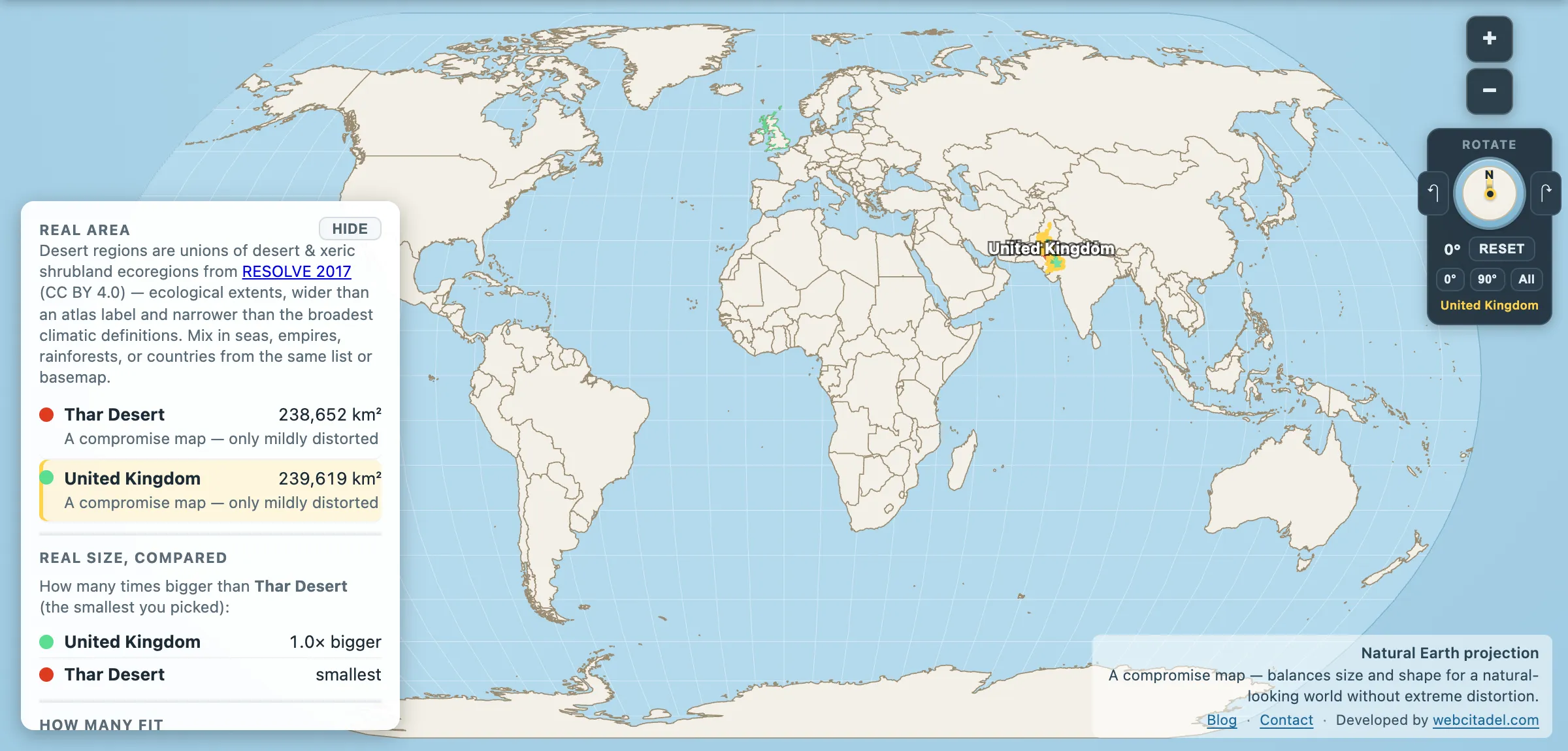
Thar Desert: 238,652 km². United Kingdom: 239,619 km².
The difference between them is 967 km² — four tenths of one per cent. As close to identical as two shapes on this map ever get.
Now hold that thought, because one of these two is a country with sixty-eight million people, motorways and a rail network, and the other is the part of the map that gets coloured beige and left alone. Estimates for the Thar’s population run from about 16 million to nearly 30 million.
The desert that forgot to be empty
The Thar sprawls across the India–Pakistan border, most of it in Rajasthan, the rest running into Pakistani Sindh and Punjab. It is routinely described as the most densely populated desert on Earth, and the figure usually quoted is around 83 people per square kilometre in a landscape that gets a few inches of rain a year. The Sahara, for comparison, runs at fewer than one.
How? Partly because the Thar is a monsoon desert rather than a subtropical one. It sits at the dry edge of the summer monsoon rather than under a permanent high-pressure lid, so it gets a short, violent, unreliable wet season instead of nothing at all. That’s enough for millet, for grazing, for stepwells, for a way of life built entirely around water arriving late and leaving early.
And partly because of the Indira Gandhi Canal, which since the 1960s has dragged Himalayan meltwater several hundred kilometres into the sand and turned strips of northern Rajasthan into farmland. Irrigation in a desert is never a free lunch — waterlogging and salinity have followed the canal like a shadow — but it moved the population line a long way into territory the map still colours as waste.
Jaisalmer, and the trade the sand paid for
The other reason people are here is that they were always here. The Thar sat on caravan routes between the Indus and the Gangetic plain, and the cities that grew on those routes were not outposts. Jaisalmer’s fort, built in 1156 from the same yellow sandstone as the ground it stands on, is one of the very few forts anywhere still lived in — several thousand residents inside the walls, with all the plumbing problems that implies for a building older than most countries.
The wildlife is doing the same trick as the people. Blackbuck, chinkara, desert fox, and the great Indian bustard, one of the heaviest flying birds on the planet and now down to a population you could seat in a school hall.
Swap the camel for a country
Open Thar vs the UK on Natural Earth. Britain has been dragged off the Atlantic and dropped onto Rajasthan, where it covers the desert almost exactly. That is the easy half of the point.
The hard half is what you do with that. Britain is a place you can name forty towns in. The Thar is a beige patch with a camel on it. Same area, to within a rounding error — and up to thirty million people live on the beige patch. It was never blank; the map just never had a way to say so.
See also the Gobi, which is the size of Mongolia, and the Sahara against the entire United States.
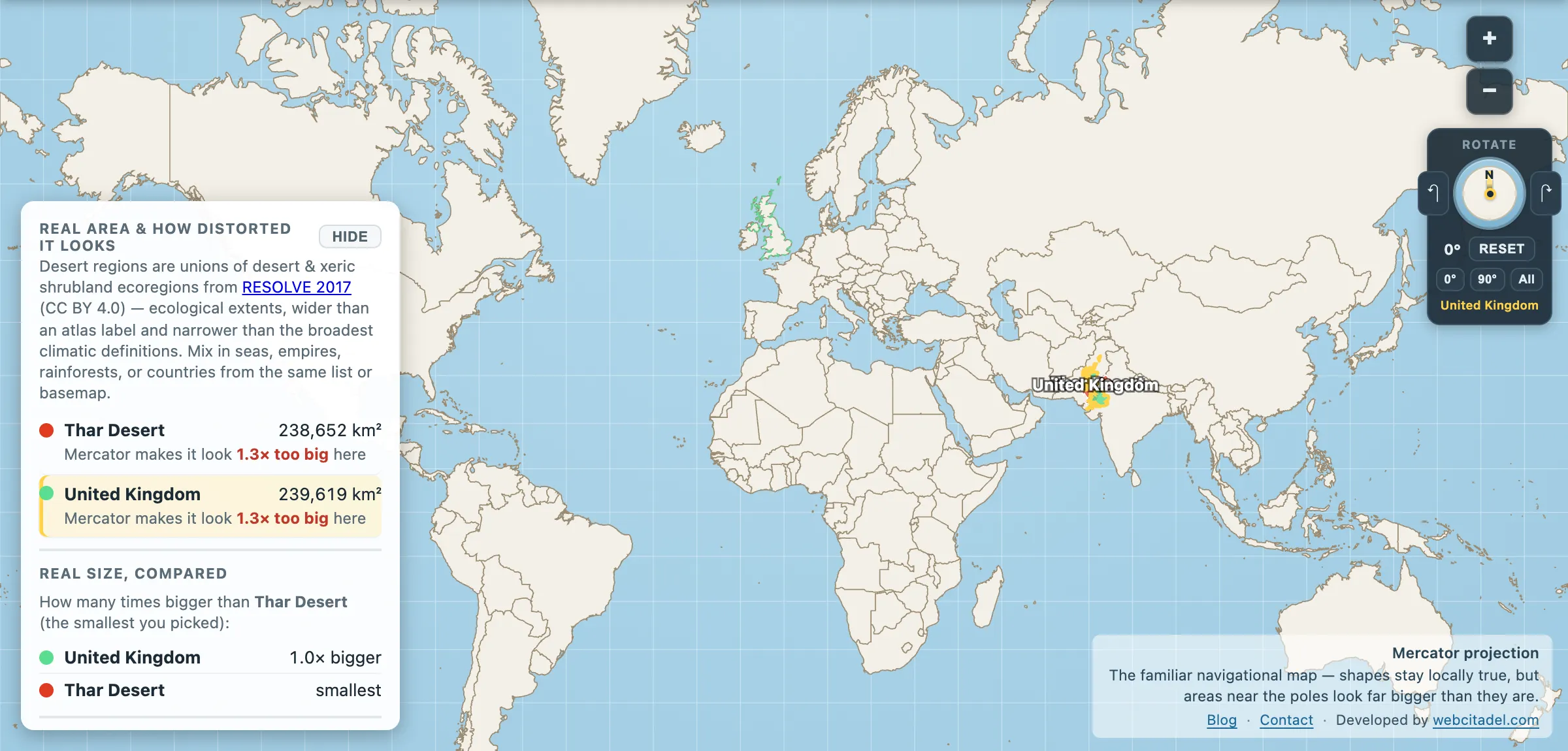
The same shapes on Mercator — the projection almost every map you see uses. Watch what it does to anything far from the equator.
Sources & methodology
- Thar outline/area: union of Desert & Xeric Shrubland ecoregions from RESOLVE Ecoregions 2017 (CC BY 4.0), as used in Map Real Size. Other definitions of the Thar run from roughly 200,000 to 240,000 km² depending on where the arid boundary is drawn — desert edges are argumentative by nature.
- United Kingdom: country area in the app (239,619 km²).
- Population: published estimates for the Thar vary widely — commonly quoted figures run from about 16 million to nearly 30 million, and the density figure of roughly 83 people per km² is the one most often cited. All of them depend on where the desert’s boundary is drawn.